A Complete Guide to ANSI, ASME, and DIN Pipe Tee Standards
When it comes to industrial plumbing systems, knowing and following international standards is very important for safety, speed, and making sure that everything works together. This all-inclusive guide goes into detail about how ANSI (American National Standards Institute), ASME (American Society of Mechanical Engineers), and DIN (Deutsches Institut für Normung) standards affect pipe tips. In the oil and gas, chemical processing, and water treatment businesses, pipe tees are crucial parts. Pipe tees are used to form a branch connection in a pipe system where the fluid may flow from a main run into another line or to mix flow from multiple directions. A tee may seem like a simple form, but choosing the appropriate fitting is more than just the nominal diameter. The right tee for a pipe system is the one that fits the application (standard, material grade, wall thickness, end preparation, pressure requirements, and dimensional compatibility). In multinational projects it is usual to see references to ANSI, ASME, and DIN; however, they do not correspond to the same sets of norms. Knowing what each standard framework contains may assist engineers, contractors, and procurement teams in preventing mismatched fittings and making more educated buying choices.
Understanding How ANSI, ASME, and DIN Standards Relate to Pipe Tees
What ANSI Means in North American Piping?
ANSI – American National Standards Institute. The body that oversees the development and approval of standards in the United States. Therefore, in pipeline applications, it is more correct to speak about individual ASME, ASTM, and other relevant standards rather than regarding ANSI as a single pipe tee manufacturing specification.
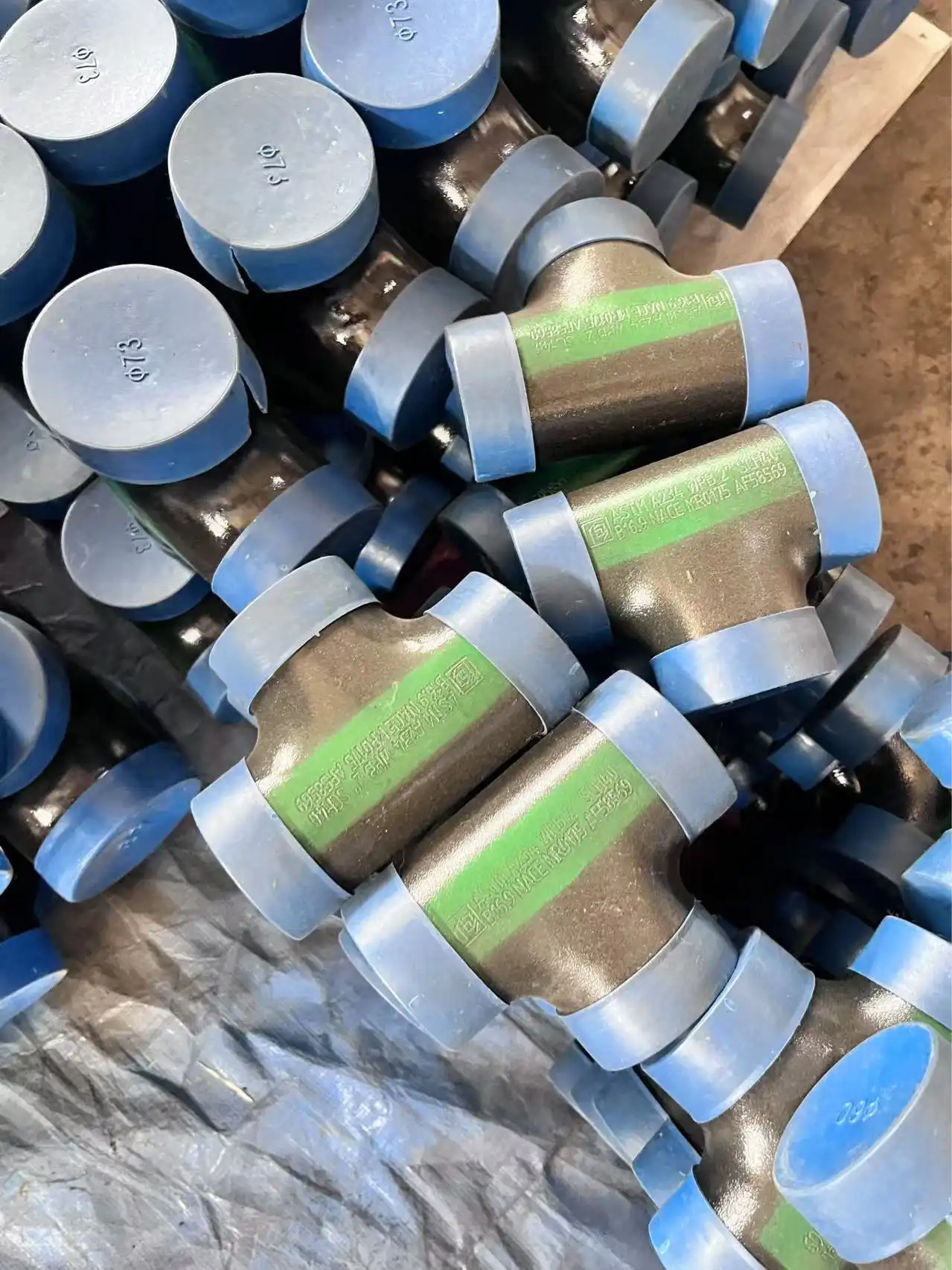
ASME B16 standards are very relevant for many industrial plumbing installations in North America. For example, ASME B16.9 includes factory-made wrought butt-welding fittings, including popular tee configurations. Then, material specifications may be defined independently by ASTM standards such as ASTM A234 for wrought carbon steel and alloy steel fittings.
This difference is important in the examination of technical texts. A procurement specification may stipulate that a tee adhere to ASME B16.9 for dimensions and manufacturing standards and ASTM A234 WPB for the material. The two standards serve distinct functions, and both may be required to adequately specify the completed fitting.
How ASME Defines Fitting Requirements?
ASME publishes many of the technical standards for industrial pipe components. For pipe tees, one of the most significant references is ASME B16.9 when the fitting is a factory-made wrought butt-welding component. It contains dimensions, tolerances, and other relevant specifications that enable fittings to connect reliably with pipelines constructed to the same dimensional system.
ASME standards are not material-specific. A tee may be made of carbon steel, stainless steel, or alloy steel, as long as the material used and the corresponding product specification meet the requirements of the project. And this is why an engineer should never call a fitting just an "ASME tee.” The specification would generally need to contain the necessary ASME standard as well as the material grade and dimensional details.
For example, a carbon steel tee may be described as an ASME B16.9 fitting made from ASTM A234 WPB material. Sometimes an application in stainless steel may call for an ASTM A403 material grade instead. The right mix is a function of the service circumstances and the project requirements.
Where DIN Standards Fit Into International Projects?
DIN is the abbreviation for standards created by the German Institute for Standardization. European and international engineering projects often incorporate DIN-based criteria, and many European applications use EN standards as well. The conclusion is that a project specification should be verified carefully rather than assuming that a single DIN document applies to all European plumbing components.
One of the most obvious distinctions between various North American and European dimensional systems is the use of nominal diameter identifiers. DN values are often found in DIN and EN pipe documents, whereas NPS designations are used in ASME-based systems. Pressure designations may also be stated in other terms, PN being prevalent in European standards.
This is not to say that a DN marked tee may be used in lieu of an NPS tee of equivalent nominal size. Before you substitute pipe tees, you must compare the real outer diameter, wall thickness, end preparation, and relevant dimensional standard.
Comparing Materials Used for Different Pipe Tee Applications
Carbon Steel Tees for General Industrial Piping
Carbon steel is the most used material for pipe tees. It is a sensible compromise between strength, availability, machinability, and cost. ASTM A234 WPB is a typical material specification for wrought carbon steel fittings used in conjunction with process pipes for ASME-based projects.
Depending on the product and the relevant material standard, DIN- or EN-based projects may show multiple material designations. Grades such as P235GH or P265GH may be used for European high-temperature or pressure-related applications, but the actual grade must always be checked from the project specification rather than presumed from the nominal size of the fitting.
The material should be chosen considering the operating temperature, design pressure, fluid properties, corrosion circumstances, welding conditions, and any code restrictions. Even a tee that is of the right size may not be acceptable for the application if it is of the incorrect material grade.
Therefore, for procurement teams the material certificate is as vital as the dimensional requirement. Maintain traceability throughout the project, checking material grade, heat number, appropriate standard, and inspection paperwork prior to installation.
Stainless Steel Tees for Corrosive or Hygienic Services
Stainless steel pipe tees are typically used in applications where corrosion resistance, cleanliness, or resistance to particular process fluids is vital. Typical grades are 304/304L and 316/316L; however, the ultimate choice is dictated by the service environment.
ASTM A403 covers wrought austenitic stainless steel pipe fittings for ASME-based systems. If the fitting is a butt-welding fitting covered by ASME B16.9, dimensioning may be in accordance with the standard. The grade designation should not be seen as immediately interchangeable. Equivalent or similar stainless steel grades under EN or DIN-related material standards may be used in European projects.
For example, 316 and 1.4401 are often linked with comparable families of stainless steel, but the equivalence should be verified in the relevant material specification, not by reference to the number designation alone. Standards may vary in carbon content, mechanical requirements, heat treatment, and certification criteria.
This is particularly significant in chemical processing, food processing, pharmaceutical facilities, and other situations where the surface condition of the fitting and material compatibility might impact the entire plumbing design.
Alloy Steel Tees for Elevated-Temperature Service
Alloy steel tees are utilized in a pipe system when mechanical performance greater than that of normal carbon steel is required, especially at extreme temperatures. Common examples of ASME/ASTM materials include ASTM A234 WP11 and WP22, which are often linked with chromium-molybdenum alloy steel fittings.
Different material identification systems are in use, and in high-temperature applications, grades like 13CrMo4-5 are encountered in European standards and grades. But these materials should not be thought of as interchangeable just because the applications they are designed for seem similar. The chemical composition, mechanical qualities, heat treatment, and design-code requirements must all be examined.
In power generation and other high-temperature applications, creep resistance and long-term material performance may become key design issues. Pipe tees should thus be chosen as part of a comprehensive pipe system rather than as separate components.
How Dimensions Affect Pipe Tee Compatibility?
Nominal Size, Outside Diameter, and Wall Thickness
Nominal size is a useful method to identify a tee but may not necessarily correspond to its actual measured diameter. ASME-based piping systems are often based on the nominal pipe size or NPS, with an outer diameter and a defined wall thickness or schedule.
Schedule designations such as SCH 10, SCH 40, SCH 80, and SCH 160 denote distinct wall thickness ranges for the pipe diameters they apply to. The fitting must fit the pipe that will be welded on to it, so pipe tees must be selected with compatible wall thicknesses and end dimensions. Therefore, selecting a tee based purely on nominal diameter might lead to issues if the wall thickness or end dimensions are not compatible.
In the DIN and EN systems, DN designations and metric dimensions are used. DN and NPS systems are not just two names for the same dimensional series; thus, engineers should check the real dimensions when connecting equipment or pipelines from various standards.
End Preparation and Bore Dimensions
The butt-welding pipe tees' end preparation is closely connected to the installation. The fitting should be capable of providing proper welding contact with the connected pipe, such as proper outer diameter, wall thickness, bevel arrangement, and dimensional tolerance.
The interior bore is also important since a sharp difference between pipe and fitting might impact flow characteristics and could produce extra turbulence. In certain applications it is of special importance to have an even internal profile.
If a project has components made to various specifications, the procurement team should not only depend on nominal size. By comparing dimension drawings to standard tables before ordering, difficulties in manufacturing and field installation may be avoided.
Equal and Reducing Tee Configurations
A tee has the same nominal diameter across the run and branch (an equal tee) or a smaller branch connection (a decreasing tee). The selection is dependent upon the desired branch flow and piping system arrangement.
Reducing tees may make a pipe system simpler by providing the needed diameter transition in one fitting. However, the dimensions chosen must be compatible with the linked pipe diameters and the standard fitting used.
The stress distribution and reinforcing needs are also affected by the branch geometry. The fitting itself may meet the applicable manufacturing standard, but the whole pipe system must be assessed under the design code for the installation.
What Engineers Should Check Before Ordering Pipe Tees?
Match the Fitting Standard With the Project Specification
The first step is to identify the actual standard required by the project. Instead of specifying only “ANSI pipe tee” or “DIN pipe tee,” the purchase description should identify the applicable technical standard whenever possible.
For an ASME-based butt-welding fitting, this may involve ASME B16.9 together with the required ASTM material specification. A European project may reference EN or DIN requirements depending on the engineering documentation. The purchasing team should use the project specification as the controlling document when there is a conflict between general catalog information and project requirements.
Confirm Material, Size, and Wall Thickness
The material grade should be checked together with the nominal size and wall thickness. These three details determine whether the fitting can be integrated into the intended piping system.
For carbon steel applications, a buyer may need to confirm whether ASTM A234 WPB is required. For stainless steel, ASTM A403 grades may be specified. Alloy steel applications may require specific chromium-molybdenum grades. The exact requirement should come from the engineering specification rather than from a generic material recommendation.
Review Inspection and Documentation Requirements
For industrial projects, documentation can be as important as the physical fitting. Depending on the application, buyers may need material certificates, dimensional inspection records, heat-treatment records, test documentation, or other quality records.
Marking on the fitting, including pipe tee identification, should also be checked against the purchase specification. Clear identification of size, material, standard, and manufacturer information supports traceability during receiving inspection and later maintenance.
A manufacturer that can provide consistent documentation alongside the physical product can make international procurement considerably easier, particularly when fittings are being shipped across different regulatory or engineering environments.
Choosing Between ASME-Based and DIN-Based Pipe Tee Systems
The choice between ASME-based and DIN-based pipe tees is normally determined by the existing piping system rather than by a simple preference for one standard. If the project has been designed around NPS dimensions and ASME B16 standards, using a fitting that follows the same dimensional system can simplify compatibility.
A DIN or EN-based system may be more appropriate when the project documentation, connected equipment, valves, and existing piping all follow metric European dimensions. Using a different dimensional system may require additional verification and, in some cases, transition components.
The material standard should also remain consistent with the engineering requirements. Two fittings may appear similar externally while having different material designations or certification requirements. This is why dimensional compatibility and material equivalence should both be verified before substitution.
For international projects, the safest approach is to treat the standard as part of the complete product specification. Size, fitting type, material, wall thickness, end preparation, pressure or design requirements, inspection, and marking should be reviewed together.
Why Standard Compliance Matters in International Procurement?
Standard compliance is not simply a documentation exercise. It affects whether a fitting can be installed efficiently, whether it matches the connected pipe, and whether its material and manufacturing characteristics meet the project's engineering requirements.
This becomes more important when purchasing from overseas manufacturers. A supplier may offer a tee with a similar nominal size but manufacture it according to a different dimensional system. Without checking the applicable standard, a buyer could receive a product that looks correct but requires modification or cannot be used as planned.
A clear technical inquiry should therefore state the required standard, size, material grade, tee configuration, schedule or wall thickness, end connection, quantity, and documentation requirements. Providing this information at the quotation stage reduces misunderstandings and allows the manufacturer to confirm whether the requested specification can be supplied.
Conclusion
Understanding ANSI, ASME, and DIN references is essential when selecting pipe tees for industrial piping systems. ANSI should not be treated as a standalone pipe tee manufacturing specification; instead, engineers should identify the specific ASME, ASTM, DIN, or EN standards applicable to the fitting, material, and project. ASME B16.9 is particularly important for many factory-made wrought butt-welding fittings, while ASTM material standards can define the material used to manufacture them.
DIN and EN-based systems may use different dimensional and material designation methods, so nominal size alone is not enough when comparing fittings from different standards. Before purchasing, engineers and procurement teams should verify the applicable standard, material grade, dimensions, wall thickness, end preparation, configuration, inspection requirements, and documentation. This approach reduces compatibility risks and helps ensure that the selected pipe tees are suitable for the actual piping system.
Reliable Pipe Fittings for International Piping Projects
Cangzhou Oudi Pipe Manufacturing Co., Ltd. has been manufacturing carbon steel pipe fittings, valves, and flanges, including pipe tees, since 1998 and serves customers in multiple international markets. For projects requiring ASME- or DIN-related specifications, the purchasing team can confirm the required fitting standard, material grade, dimensions, and documentation before production.
Whether you need equal tees, reducing tees, carbon steel fittings, stainless steel fittings, or other piping components, providing the complete technical specification allows the manufacturer to match the product more accurately with your project requirements. Contact Cangzhou Oudi Pipe Manufacturing Co., Ltd. to discuss your pipe tee requirements and confirm the appropriate standard before placing an order. Contact us at oudi-04@oudiguandao.com to learn more about our products and services.
References
1. American National Standards Institute (ANSI). (2019). ANSI B16.9: Factory-Made Wrought Buttwelding Fittings.
2. American Society of Mechanical Engineers (ASME). (2020). ASME B31.3: Process Piping.
3. Deutsches Institut für Normung (DIN). (2018). DIN EN 10253-2: Butt-welding pipe fittings—Part 2: Non-alloy and ferritic-alloy steels with specific inspection requirements.
4. Smith, J. R. (2021). Comparative Analysis of International Pipe Fitting Standards. Journal of Piping Engineering, 45(3), 178-195.
5. Johnson, M. L., & Thompson, R. K. (2020). Material Selection for Industrial Piping Systems: A Comprehensive Guide. Industrial Piping Handbook, 3rd Edition.
6. International Organization for Standardization (ISO). (2017). ISO 5251: Stainless steel butt-welding fittings.

Need help finding the right solution with our experts. Please contact us.

SINCE 1998 Your Reliable Pipeline Manufacturer



