How to Read Carbon Steel Elbow Dimension Tables Correctly?
Reading a dimension table correctly is one of the basic skills needed when specifying or purchasing a carbon steel elbow for a piping project. A dimension table may seem to be a simple list of numbers, but each value specifies a specific portion of the fit and must be read in conjunction with the others. Mismatches in nominal size, wall thickness, radius, or end-to-end dimension may cause complications during installation and may need revisions to the pipe plan. For engineers, buyers, fabricators, and maintenance teams, the first step is to grasp what the table is really saying. Different standards and manufacturers may arrange their data differently. Therefore, a dimension should never be understood without reference to the appropriate standard, fitting type, unit system, and size identification. For example, ASME B16.9 sets dimension standards for wrought, factory-made butt-welding fittings and gives separate tables for long radius elbows, short radius elbows, and various fitting types. This manual will walk you through a typical carbon steel elbow dimension table, outlining the meaning of the most frequent terminology and pointing out features that need special attention before an elbow is chosen or purchased.
Start With the Standard and Fitting Type
Before looking at individual values, determine the standard that is utilised for the dimension table. This is a critical stage; dimensions are not universal for each kind of fitting. A table that is produced for a butt-welding elbow should not be used to define a threaded or socket-weld fitting, and a manufacturer’s bespoke measurement should not be utilised as a standard dimension without confirmation.
ASME B16.9 is a dimensional specification for several industrial butt welding applications. Its published information contains specifications for fitting measurements, tolerances, surface contours, end preparation, marking, materials and testing. Also, long radius elbows, short radius elbows, and 3D elbows are split into distinct dimension tables.
This is important because two elbows may both be defined as 90-degree fits with varying center-to-end diameters. The angle does not fully determine the whole geometry of the fitting. The purchaser should consequently ascertain elbow angle, radius type, nominal size, wall thickness or schedule, material specification, and connection before comparing measurements.
The same is true when you deal with a manufacturer’s own catalogue. Where the catalogue shows a special dimension, reduced fitting or non-standard configuration, the customer should determine whether such dimension is to a recognised standard or has been created to an accepted design.

Read NPS Without Confusing It With Actual Diameter
The first field in a carbon steel elbow dimension chart is nominal pipe size. It is usually expressed as NPS. It gives the notional size of the pipe or fitting rather than just the actual outer diameter.
This is an essential difference since NPS values are not intended as direct measures. For example, NPS designation is a standardised manner of designating pipe size, although the actual outside diameter relies on the relevant pipe dimensions standard. For example, ASME B36.10 standardises dimensions of welded and seamless wrought steel pipe.
Hence, when choosing an elbow for an existing pipeline, the NPS should be confirmed with the pipe specification and not deduced from a physical measurement alone. If the pipe is called out in the project documents as a certain NPS, such designation will follow through to the fitting selection.
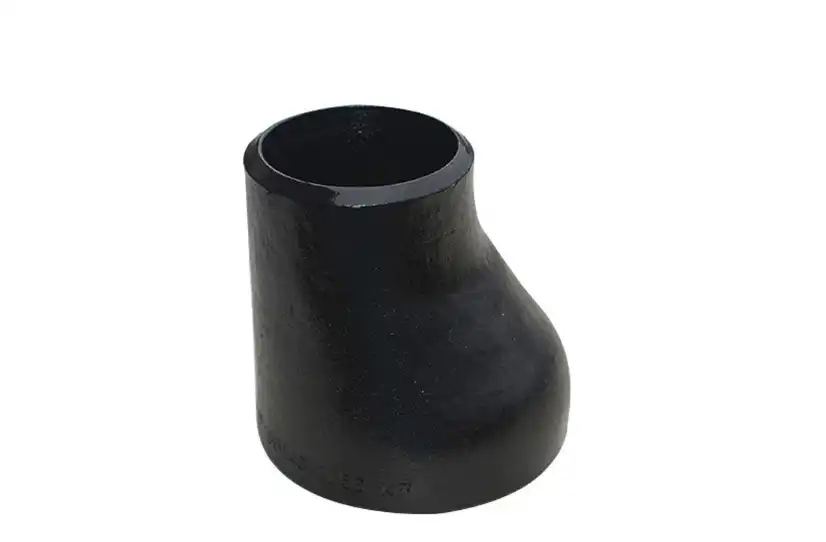
Also worth determining if the elbow is the same size or shrinking. same elbow has the same nominal size at both ends, while a decreasing elbow has varying opening sizes. A dimension table may have distinct columns or separate sections for various setups, so the reader should verify the fitting type before utilising any dimensional number.
Understand Outside Diameter and Wall Thickness Together
For outside diameter and wall thickness. For various information. The outside diameter is the exterior dimension of the pipe or the end of the fitting, while wall thickness is the thickness of the material between the outside and inner surfaces.
Wall thickness is especially significant when a carbon steel elbow is linked to a pipe of a specific thickness or Schedule. Elbows of the same NPS may not have the same wall thickness. The fitting used must consequently be compatible with the pipe specification and not only the nominal size.
This is a frequent error in reading. The customer may look up the proper NPS in a table and believe that the fitting is ready to purchase, even if the appropriate wall thickness has not been verified. In a welded piping system, the pipe and elbow should be compatible as to size, wall thickness, material specification, and relevant joining criteria.
The final preparation also demands attention. ASME B16.25 covers preparation of buttwelding ends, including welding bevels, internal and exterior shaping for heavy-wall components, dimensions, and tolerances. Thus, the dimension table should not be used as the only source of information when the project additionally includes special welding needs.
Distinguish Elbow Angle From Radius
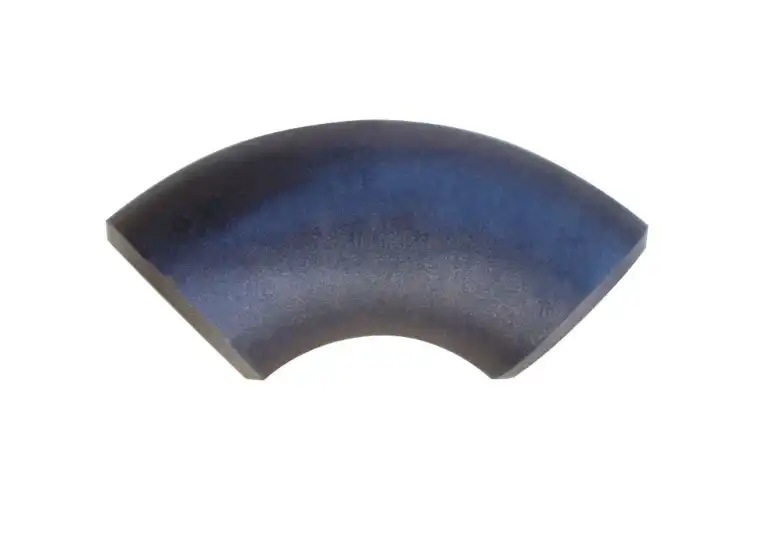
A 45-degree elbow and a 90-degree elbow describe different changes in the direction of the pipeline. The angle indicates how much the pipeline changes direction, while the radius describes the curvature of the elbow.
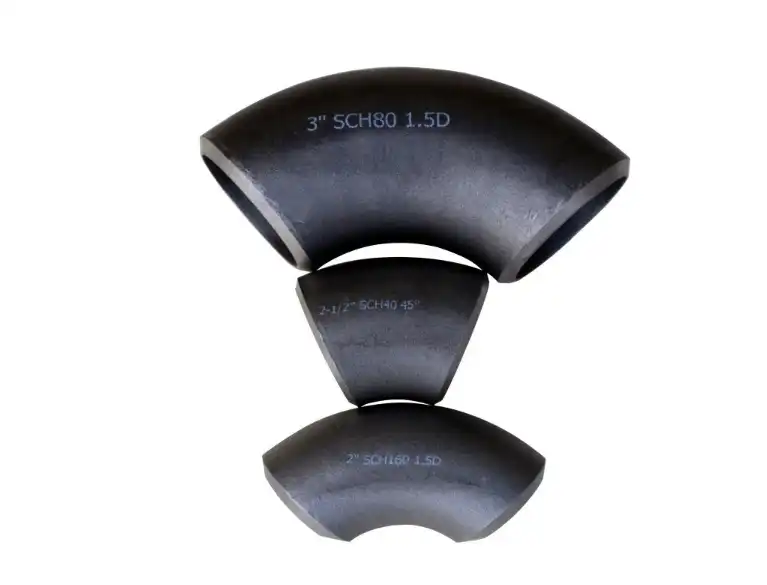
Long radius and short radius should therefore not be treated as alternative names for elbow angles. A 90-degree elbow, for example, can be manufactured as a long radius or short radius configuration. The two fittings can have different center-to-end dimensions even though both redirect the pipe by 90 degrees.
A dimension table normally makes this distinction through separate product descriptions or dimensional sections. ASME B16.9, for example, includes separate dimensional tables for long radius and short radius elbows.
When reading the table, first identify the angle and then determine the radius configuration of the carbon steel elbow. After that, compare the corresponding center-to-end dimension. This sequence is much more reliable than selecting an elbow simply because its angle matches the drawing.
Find the Center-to-End Dimension
The center-to-end dimension is one of the most useful measurements when checking whether an elbow will fit a piping layout. It describes the distance from the theoretical centerline of the fitting to the end of the elbow.
This measurement becomes especially important when replacing an existing fitting or designing a compact piping arrangement. If the new elbow has a different center-to-end dimension from the original component, the connected pipe may no longer align with the existing layout.
For a long radius elbow, the center-to-end dimension is generally larger than that of a comparable short radius elbow. That difference affects the amount of space required for installation. It can also influence the geometry of the surrounding pipework, particularly when several elbows are installed close to one another.
The best practice is to compare the dimension in the table with the actual available space shown on the piping drawing. Do not assume that two elbows with the same NPS and angle will occupy exactly the same space.
Check Units Before Comparing Numbers
Dimension tables may use U.S. customary units, metric units, or both. Before comparing values, confirm whether the dimensions are given in inches or millimeters and whether the manufacturer has provided a separate metric conversion.
This sounds straightforward, but unit confusion can create significant specification errors. A dimension such as 2 inches should not be treated as 2 millimeters, and a weight value should not be compared across tables until the unit system has been identified.
It is also useful to check the table heading and the notes below the table rather than relying only on the column labels. Some manufacturers place unit information in the table title, while others specify it in a separate note.
For international projects, keeping the original unit alongside the converted value can also help reduce communication problems between engineering, procurement, fabrication, and inspection teams. When a purchase order is prepared, the unit should be stated clearly so that the supplier and buyer are working from the same dimensional basis.
Check Wall Thickness or Schedule Separately From Size
A carbon steel elbow cannot be fully specified by NPS alone. The required wall thickness or Schedule should also be confirmed when the project specification uses Schedule designations.
Schedule is a standardized way of describing pipe wall thickness relationships within a given nominal size range, but the actual wall thickness must be checked against the applicable pipe standard and size. For this reason, a purchaser should not assume that a particular Schedule means exactly the same physical thickness for every NPS.
The dimension table may show wall thickness directly, provide a Schedule reference, or organize different configurations into separate sections. Read the table according to the manufacturer's stated format and then compare the value with the connected pipe specification.
This is especially important for replacement work. An elbow that matches the NPS but has an incompatible wall thickness may create welding, alignment, or specification issues. The correct selection requires the dimensions of both the fitting and the pipe to be considered together.
Do Not Use the Dimension Table Alone to Determine Pressure Suitability
Dimension tables are useful for identifying physical geometry, but they should not be treated as a complete pressure-design calculation.
The pressure suitability of a piping component depends on more than its outside diameter and wall thickness. Material grade, design temperature, applicable piping code, manufacturing standard, component configuration, and pressure-temperature requirements may all be relevant. Consequently, simply choosing an elbow with a thicker wall does not automatically establish that it is suitable for a particular service.
The same principle applies to pressure class terminology. Different types of fittings use different systems for describing pressure capability, and the meaning of a pressure designation should always be checked against the relevant standard.
For a project involving elevated pressure or temperature, the dimension table should be used together with the applicable engineering specification and design code. If the manufacturer provides pressure-temperature information, material certificates, or technical documentation, those documents should also be reviewed before the fitting is approved.
Consider Flow Without Overinterpreting the R/D Ratio
Elbow geometry can affect the behavior of fluid moving through a piping system, particularly when the system contains many changes in direction. Long radius elbows generally provide a more gradual change in direction than short radius elbows, which can be relevant when engineers are considering pressure loss and available installation space.
Some technical documents use an R/D ratio to describe carbon steel elbow geometry, where R represents the centerline radius and D represents the nominal or reference pipe diameter according to the applicable convention. The ratio can help describe the geometry, but it should not be interpreted as a universal measure of “better” flow performance.
Actual pressure loss depends on the complete piping arrangement, fluid properties, flow conditions, fitting geometry, and other system factors. Therefore, a dimension table can tell you the elbow's physical geometry, but it does not replace hydraulic calculations.
For a purchaser, the practical lesson is simple: use the dimension table to identify the correct elbow geometry, and use engineering calculations or project specifications to evaluate flow performance when pressure loss is important.
Match the Elbow to the Existing Connection
The connection method must match the piping system. For butt-welding applications, the elbow end preparation needs to be compatible with the pipe and the applicable welding procedure. ASME B16.25 specifically addresses the preparation of butt-welding ends, including bevel geometry and dimensional tolerances.
Threaded, socket-weld, and butt-weld fittings should not be treated as interchangeable simply because their nominal sizes are similar. They use different joining methods and may be governed by different dimensional standards.
When replacing an existing carbon steel elbow, inspect the connection at both ends and confirm the pipe size, wall thickness, end type, and material requirements. For new construction, compare the fitting specification with the piping class or line list used by the project.
This is also where the manufacturer's technical drawing becomes valuable. If the catalog does not provide enough information to confirm the end geometry, asking for a dimensional drawing is preferable to making assumptions from a product photograph.
Conclusion
Learning how to read carbon steel elbow dimension tables is much more useful than simply memorizing a few common fitting sizes. The key is to understand how the different pieces of information relate to one another. Start by confirming the applicable standard and fitting type, then identify the NPS, angle, radius, center-to-end dimension, wall thickness, and unit system. From there, check the connection type and compare the fitting with the pipe specification it will join.
It is equally important to recognize the limits of a dimension table. Physical dimensions can confirm whether an elbow is likely to fit a piping layout, but pressure suitability, welding requirements, material selection, and hydraulic performance may require additional standards and engineering documentation. ASME publications, for example, distinguish fitting dimensions from butt-welding end preparation requirements, reinforcing the need to review the relevant standards rather than relying on a single catalog table.
For buyers and engineers, this approach makes specification work more precise and reduces avoidable communication errors. For manufacturers, providing clear dimensional drawings, applicable standards, material information, and consistent product specifications makes it easier for customers to verify that the selected fitting matches their piping requirements.
Cangzhou Oudi Pipe Manufacture Co., Ltd. manufactures carbon steel, stainless steel, and alloy steel pipe fittings for industrial applications. The company states that it has operated since 1998 in Mengcun Hui Autonomous County, China, and supplies fittings manufactured to various international standards. When evaluating a supplier, customers should confirm the specific material grade, dimensional standard, inspection requirements, and certification documents applicable to their order rather than relying only on general product descriptions. For more information or inquiries, please contact us at oudi-04@oudiguandao.com.
FAQ
1. What is the most important information to look for in a carbon steel elbow dimension table?
The most crucial information includes nominal pipe size, outside diameter, wall thickness, center-to-end distance, and pressure rating.
2. How do I determine if a carbon steel elbow is suitable for high-pressure applications?
Check the wall thickness and pressure rating in the dimension table. Higher values generally indicate suitability for higher-pressure applications.
3. What's the difference between long radius and short radius carbon steel elbows?
Long radius elbows have a larger center-to-end distance and offer lower flow resistance, while short radius elbows are more compact but may introduce greater turbulence.
4. How can I ensure compatibility between a new carbon steel elbow and an existing piping system?
Verify that the end connections, outside diameter, and wall thickness match or are compatible with your existing system specifications.
References
1. Smith, J. (2019). Understanding Carbon Steel Pipe Fittings: A Comprehensive Guide. Industrial Piping Journal, 45(2), 78-92.
2. Johnson, M. R., & Williams, P. (2020). Interpreting Dimension Tables for Piping Components. Mechanical Engineering Handbook (5th ed.). New York: Engineering Press.
3. Thompson, L. K. (2018). Flow Characteristics of Carbon Steel Elbows in Industrial Applications. Journal of Fluid Dynamics, 32(4), 412-425.
4. Garcia, R., & Lee, S. (2021). Pressure Ratings and Material Selection for Carbon Steel Fittings. Chemical Engineering Quarterly, 56(3), 201-215.
5. Brown, A. J. (2017). Compatibility Considerations in Piping System Design. Plant Engineering Magazine, 89(6), 45-52.
6. Wilson, D. T., & Taylor, E. M. (2022). Advances in Carbon Steel Elbow Manufacturing and Standards. International Journal of Metallurgy, 28(1), 67-80.

Need help finding the right solution with our experts. Please contact us.

SINCE 1998 Your Reliable Pipeline Manufacturer