How to Identify Fake or Substandard Carbon Steel Elbows?
Carbon steel elbows are widely used to change the direction of piping runs in industrial systems, but their appearance alone does not tell you whether a fitting is suitable for the specified service. A product may look acceptable while having the wrong material grade, incorrect wall thickness, poor forming quality, incomplete traceability, or documentation that does not match the actual batch. For this reason, identifying questionable carbon steel elbows requires more than a quick visual inspection. Buyers need to compare the physical fitting with the purchase specification, applicable standards, material documentation, dimensional requirements, and, when necessary, independent test results. For factory-made butt-welding fittings, ASME B16.9 provides requirements related to dimensions, tolerances, ratings, materials, and marking. ASTM A234/A234M covers wrought carbon steel and alloy steel fittings of both seamless and welded construction for moderate- and high-temperature service and includes requirements associated with mechanical and hydrostatic testing. These standards provide a much stronger basis for evaluating a fitting than appearance or price alone.
Start With the Product Specification and Traceability
Match the Elbow to the Purchase Specification
Before inspecting the physical product, confirm what was actually ordered. The nominal pipe size, outside diameter, wall thickness or schedule, bend angle, radius, material grade, manufacturing method, end preparation, and applicable standard should all be consistent with the purchase order and technical specification. A fitting that looks correct but has a different wall thickness or material grade is still a nonconforming product.
This step is particularly important because “carbon steel elbow” is a broad product description rather than a complete technical specification. An engineering project may require a particular ASTM material grade together with ASME dimensional requirements, while another project may use a different material standard or additional inspection requirements. ASTM A234/A234M, for example, covers a range of wrought carbon and alloy steel fittings rather than treating every carbon steel fitting as an identical product.
The buyer should therefore compare the product marking and inspection documents with the original purchase requirements before drawing conclusions about authenticity. If the documents specify one grade but the physical marking identifies another, the discrepancy should be investigated before the fitting is installed.
Check Heat Numbers and Material Records
Traceability is one of the most useful ways to investigate questionable fittings. A professional supplier should be able to explain how the finished elbow is connected to its production batch and material records. Depending on the project requirements, this may include a heat number, batch information, material test report, inspection record, or other documentation.
The purpose is not simply to collect paperwork. The information should form a consistent chain from the raw material to the finished fitting. The heat number on the product, when applicable, should correspond with the relevant material documentation, while the reported chemical composition and mechanical properties should be consistent with the specified material grade.
ASTM A960/A960M, which establishes common requirements for several wrought steel piping fitting specifications, includes chemical analysis and mechanical testing requirements for covered products. This illustrates why documentation and traceability are important parts of product verification. A fitting should not be accepted as genuine merely because a certificate has been provided; the certificate should also be consistent with the actual product and purchase requirements.

Inspect the Physical Condition Before Testing
Examine the Surface and Markings
A visual inspection is useful as an initial screening step, but it should not be treated as proof of material authenticity. A properly manufactured elbow should generally have a consistent shape and a surface condition appropriate to its manufacturing process. Buyers should look for obvious cracks, folds, severe dents, deep laps, excessive scale, machining damage, or other visible discontinuities that could indicate manufacturing or handling problems.
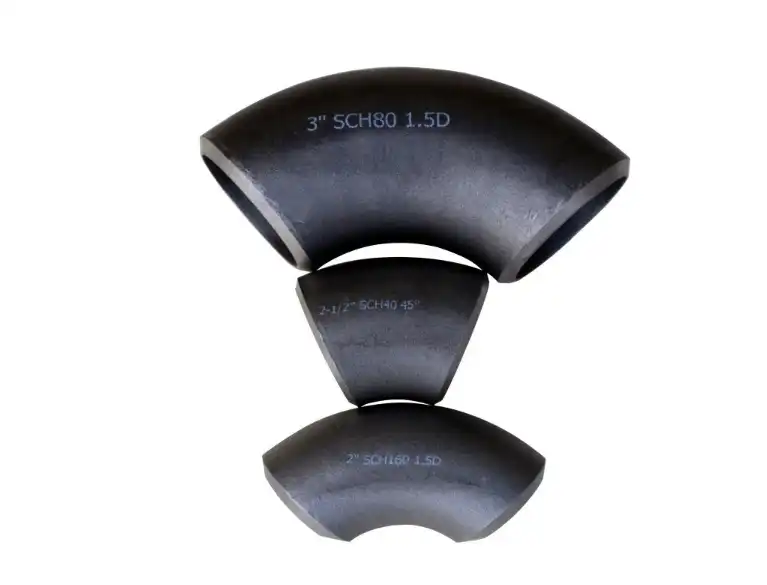
Product markings on carbon steel elbows should also be examined carefully. Depending on the applicable standard and purchase specification, markings may identify information such as the manufacturer, material designation, size, schedule, standard, or traceability information. ASME B16.9 specifically addresses marking as part of its requirements for factory-made wrought butt-welding fittings.
The important point is consistency. A marking that is difficult to read, inconsistent with the purchase order, or unrelated to the accompanying material documents deserves further investigation. At the same time, the absence of a particular marking should not automatically be described as evidence of counterfeit production because marking requirements vary with the applicable specification and order.
Verify Dimensions Rather Than Relying on Appearance
Dimensional inspection is more informative than simply deciding whether an elbow “looks right.” Measurements should be compared with the dimensional requirements specified for the product. Depending on the fitting, relevant measurements can include outside diameter, wall thickness, center-to-end dimensions, bend radius, overall dimensions, and end preparation.
ASME B16.9 provides dimensional and tolerance requirements for covered factory-made butt-welding fittings, making dimensional verification an important part of quality control. A caliper, micrometer, ultrasonic thickness gauge, or other suitable measuring equipment may be used depending on the measurement being taken and the accuracy required.
Particular attention should be paid to wall thickness. A fitting that has a noticeably thinner wall than specified may not meet the intended design requirements even if its outside appearance is satisfactory. Measurements should also be taken at appropriate locations because forming operations can produce variations around the elbow.
Assess Welded Areas According to the Manufacturing Method
If the elbow is welded, the weld area should be examined for visible defects such as cracks, undercut, excessive irregularity, poor alignment, or other indications that require further inspection. However, the inspection method should reflect the actual manufacturing process. Seamless fittings do not have a longitudinal weld seam, while welded fittings may require different inspection considerations.
Visual examination is only the first level of assessment. Where the project specification requires non-destructive examination, techniques such as radiographic or ultrasonic testing may provide information that cannot be obtained from surface inspection alone. The appropriate method depends on the product specification, weld configuration, service conditions, and purchaser requirements.
Confirm the Material Grade With Objective Testing
Use Chemical Analysis to Verify Material Identity
Chemical composition testing is one of the most direct ways to determine whether the material is consistent with the specified grade. Portable X-ray fluorescence equipment can provide rapid elemental screening for certain applications, while optical emission spectroscopy can provide more detailed analysis for suitable metallic samples.
The results should be compared with the chemical requirements of the specified material standard for carbon steel elbows, rather than with a generic definition of carbon steel. ASTM A234/A234M, for example, establishes chemical and mechanical requirements for covered wrought carbon and alloy steel fittings.
This distinction matters because two fittings can both be described commercially as carbon steel while having different grade requirements. A supplier certificate therefore becomes much more useful when its heat number, chemical composition, product designation, and other information can be matched to the actual fitting being inspected.
Treat Hardness Testing as Supporting Evidence
Hardness testing can provide useful information about material condition and heat treatment, but hardness by itself does not prove that an elbow is genuine. A suitable hardness test should be performed according to the applicable testing method and compared with the requirements for the specified grade.
Unusual hardness values or significant variations across a fitting may justify further investigation, particularly when they conflict with the material certificate or specified mechanical properties. ASTM A234/A234M includes hardness and tensile requirements for covered fittings, which demonstrates that mechanical properties are part of formal product verification rather than merely visual quality indicators.
Portable hardness testing can be useful for preliminary inspection, but project-critical verification may require a controlled laboratory test. The test location, equipment calibration, surface preparation, and applicable standard all affect the reliability of the result.
Consider Metallographic Examination When the Evidence Conflicts
Metallographic examination is normally not the first test a purchaser performs, but it can be valuable when chemical analysis, hardness results, production records, or other evidence do not agree. A prepared sample can be examined under a microscope to evaluate the material's microstructure and provide information about forming and heat-treatment conditions.
The interpretation should be performed by qualified personnel because microstructures vary with material grade, forming route, cooling history, and heat treatment. A coarse or unexpected structure should not automatically be labeled as proof of counterfeit production. Instead, it should be treated as evidence that additional investigation may be necessary.
This approach is more reliable than using one isolated test to make a final decision. For carbon steel elbows, product authenticity and conformity are usually established by combining physical inspection, documentation, material analysis, dimensional checks, and mechanical testing where required.
Verify Mechanical and Pressure Performance
Review Required Mechanical Tests
Mechanical testing provides information about whether the fitting meets the specified material requirements. Depending on the applicable standard and purchase specification, testing may include tensile strength, yield strength, elongation, hardness, impact testing, or other examinations.
ASTM A234/A234M specifies mechanical testing requirements for covered fittings, while ASTM A960/A960M establishes common requirements that include tension, hardness, impact, and hydrostatic testing for applicable wrought steel fittings. The exact tests required should therefore be determined from the material standard and project specification rather than from a generic checklist.
When reviewing a test report, buyers should pay attention to whether the reported grade, heat number, test results, and specimen information correspond to the purchased product. A certificate containing technically correct numbers is not sufficient if it cannot be linked to the actual batch.
Understand Hydrostatic Testing Correctly
Hydrostatic testing can be an important part of verifying pressure-containing fittings, but the test pressure should not be presented as a universal value for every carbon steel elbow. Requirements depend on the applicable standard, product type, design conditions, and purchase specification.
ASTM A234/A234M states that covered fittings are subjected to hydrostatic testing as part of its requirements, while the applicable standard and purchasing documents determine the specific conditions. Therefore, replacing every project-specific requirement with a blanket statement such as “test at 1.5 times working pressure” can create a misleading impression.
Pressure testing should also be performed using an appropriate controlled procedure and suitable safety measures. Buyers should review the actual test record rather than attempting to determine product quality from an informal pressure test.
Do Not Use Corrosion Testing as a Simple Authenticity Test
Carbon steel elbows can be exposed to moisture, chemicals, temperature changes, and other corrosive conditions, but corrosion behavior is strongly dependent on the service environment. A salt spray or immersion test does not automatically establish whether a particular carbon steel elbow is suitable for every industrial application.
Instead, corrosion evaluation should begin with the actual operating conditions. The fluid composition, temperature, pressure, water content, exposure duration, surface treatment, and applicable corrosion-control requirements should all be considered. If a coating or other surface treatment is specified, its own inspection and qualification requirements should also be reviewed.
This distinction is important because a fitting can meet its material and dimensional requirements while still requiring additional corrosion protection for a particular environment. Conversely, visible surface oxidation does not by itself prove that the underlying fitting is counterfeit or made from the wrong grade.
Conclusion
Identifying fake or substandard carbon steel elbows requires a combination of physical inspection, specification review, traceability checks, material verification, and appropriate performance testing. Surface appearance can help identify obvious manufacturing problems, but it cannot establish material grade or authenticity on its own. Dimensional measurements should be compared with the applicable requirements, while markings and heat numbers should be checked against purchase documents and material records.
For projects using recognized specifications, standards such as ASME B16.9 and ASTM A234/A234M provide a more reliable technical framework for evaluating factory-made fittings than visual judgment alone. When uncertainty remains, chemical analysis, hardness testing, mechanical testing, non-destructive examination, or independent inspection can provide additional evidence.
The most reliable purchasing process is therefore one that connects the physical elbow with its specification, manufacturing information, inspection records, and material documentation. By verifying these elements together, buyers can identify nonconforming products earlier and select fittings that are appropriate for the intended piping service rather than relying on appearance, brand claims, or price alone. For more information or inquiries about high-quality carbon steel elbows, please contact us at oudi-04@oudiguandao.com.
FAQ
1. What are the most common signs of a fake carbon steel elbow?
Common signs include poor surface finish, inconsistent dimensions, low-quality welds, and the absence of proper markings or certifications.
2. How important is chemical composition testing in identifying genuine carbon steel elbows?
Chemical composition testing is crucial as it verifies the exact material makeup, ensuring the elbow meets the specified grade requirements.
3. Can I perform any quality checks on carbon steel elbows without specialized equipment?
Yes, visual inspection and basic dimensional checks can be performed without specialized equipment, providing initial indications of quality.
4. What are the risks of using substandard carbon steel elbows in a piping system?
Risks include premature failure, leaks, reduced system efficiency, and potential safety hazards in high-pressure or corrosive environments.
References
1. Smith, J. (2020). "Quality Control in Carbon Steel Pipe Fittings Manufacturing." Journal of Industrial Engineering, 45(3), 78-92.
2. Johnson, R. et al. (2019). "Non-Destructive Testing Methods for Carbon Steel Pipe Components." Materials Evaluation, 77(8), 1012-1025.
3. Brown, A. (2021). "Corrosion Resistance of Carbon Steel Elbows in Industrial Applications." Corrosion Science and Technology, 56(4), 405-418.
4. Lee, S. and Park, K. (2018). "Microstructural Analysis of Heat-Treated Carbon Steel Pipe Fittings." Metallurgical and Materials Transactions A, 49(6), 2234-2246.
5. Wilson, D. (2022). "Identifying Counterfeit Pipe Fittings in Industrial Supply Chains." Supply Chain Management Review, 26(2), 45-53.
6. Zhang, L. et al. (2020). "Performance Comparison of Genuine and Substandard Carbon Steel Elbows Under High-Pressure Conditions." Journal of Pressure Vessel Technology, 142(5), 051302.

Need help finding the right solution with our experts. Please contact us.

SINCE 1998 Your Reliable Pipeline Manufacturer