Threaded or Socket-Weld? Choosing the Right Carbon Steel Pipe Tee?
Selecting a tee for an industrial piping system is not simply a matter of matching the pipe size. The connection method can affect installation, maintenance, pressure capability, inspection requirements, and the long-term behavior of the line. Carbon steel pipe tees are available with different connection configurations, and threaded and socket-weld designs are two common choices for smaller-diameter piping. They may seem identical from the outside, yet they have distinct demands for installation and operation. A threaded tee might be desirable if a line is to be installed or removed with minimum site work, whereas a socket-weld tee is generally selected when a permanent welded connection is desired. The correct decision relies on the actual operating circumstances, rather than on the presumption that one connection is superior to the other.
How Threaded and Socket-Weld Tees Differ in Practice?
Connection Design and Manufacturing Considerations
The most visible variation is in the way the tee attaches to the pipe. A threaded tee is one that mechanically connects to a threaded pipe or to another threaded component that has machined threads. The pipe configuration may be designed for relatively simple assembly, eliminating the requirement for welding during installation.
A socket-weld tee has a socket into which the pipe is put, and the junction is then welded. The fitting and pipe are then permanently welded together. This is the usual arrangement for smaller-bore pipelines when a compact welded joint is desired.
This distinction is crucial since the link itself becomes part of the technical concerns of the system. The integrity of the threaded connection is dependent on the right thread engagement, suitable components, good assembly, and an adequate sealing mechanism. The quality of the weld is important with a socket-weld connection. The installation process includes the pipe fit-up, welding method, welder qualification, and joint preparation and inspection requirements.
As for ASME B16.11, it is especially applicable to projects making use of ASME standards. The standard covers forged socket-welding and threaded fittings, and it contains ratings, dimensions, tolerances, marking, and material requirements. Threaded fittings are classified as Class 2000, 3000, and 6000, while socket-weld fittings are classified as Class 3000, 6000, and 9000.
Installation, Access, and Maintenance
In practice, the distinction between the two kinds of connections is most visible during installation.
A threaded tee may typically be built without welding equipment, which can be helpful for maintenance work, temporary setups, or areas where hot-work activities are difficult to organize. If a component must be removed, that connection may usually be dismantled rather than being cut out and rewelded later. This may lessen the amount of effort necessary for regular changes.
Socket-weld installation needs welding equipment and qualified staff. The pipe must be inserted appropriately into the socket, and the weld must be finished in accordance with the relevant process. The joint is not intended, once fitted, to be taken apart in the same manner as a threaded joint. If the tee has to be changed, the line normally has to be cut and a new fitting welded in place.
That doesn't make socket-weld fittings prohibitive for facilities that do a lot of maintenance. Rather, it indicates that maintenance planning should be taken into account before choosing the kind of connection. Having a permanent connection might be a benefit when the pipe architecture is stable and minimizing possible leakage locations is more essential than speedy disassembly.
Pressure, Temperature, and Cyclic Service
Don’t judge the pressure rating by the statement that threaded fittings are “low pressure” and socket-weld fittings are “high pressure.” The appropriate rating is based on the fitting standard, class, material, temperature, size, and pipe design criteria.
For example, ASME B16.11 has designated pressure classes for threaded and socket weld forged fittings, not a pressure limit for each connection type.
The working atmosphere is important too. A pipe system that is subjected to vibration, temperature cycling, or frequent mechanical movement may necessitate a more detailed study of the junction arrangement. Threaded connections are convenient, but the designer has to consider the possibilities of loosening, leakage, and stress concentration under the actual service circumstances. The welding process must be handled carefully, yet a welded connection may be the preferred option for a permanent union.
For process piping, this determination should be made within the constraints of the applicable piping code. For example, ASME B31.3 covers materials, components, design, fabrication, assembly, inspection, examination, and testing of pipe systems, including carbon steel pipe tees. Also, ASME B31.3 specifies particular standards for various kinds of piping joints.
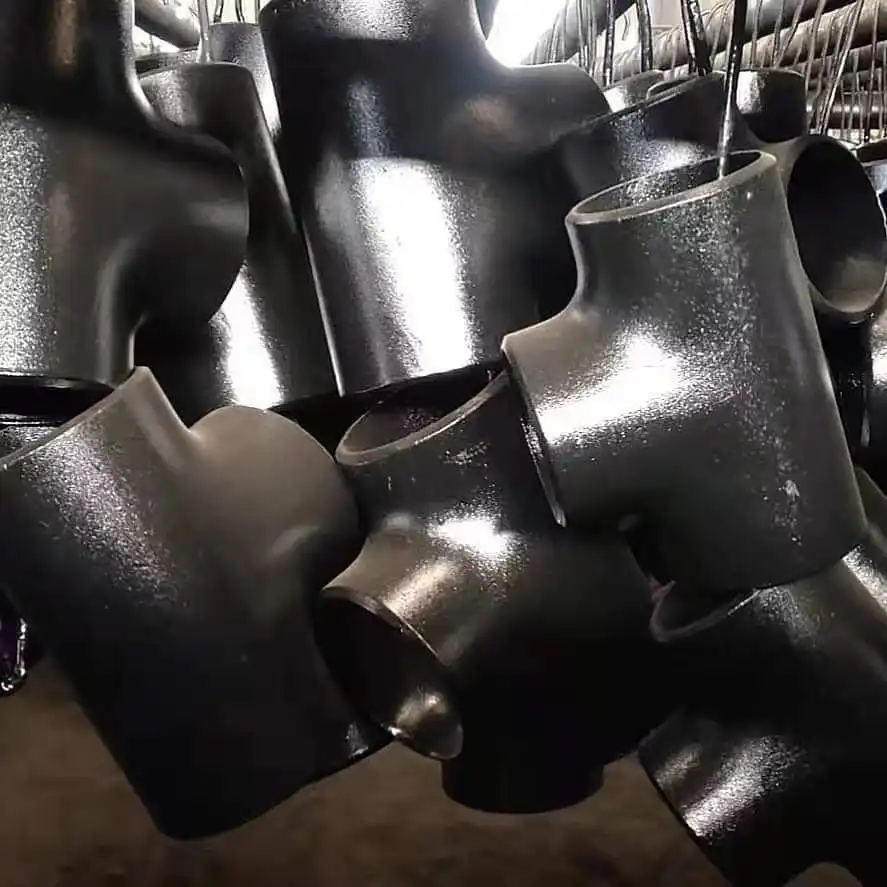
Where Threaded Carbon Steel Pipe Tees Make More Sense?
Systems That Need Frequent Modification
Threaded connections provide the advantage that the pipe layout may be changed. During the service life of a test setup, pilot installation, maintenance utility line or small process system, it may be necessary to add, remove or rearrange components.
In such cases the option to detach the tee without the need for cutting and welding might be a real operational benefit. This provides engineers and maintenance teams the ability to access certain areas of the system without having to go through expensive hot-work processes each time a fitting has to be changed.
This benefit is of less importance if the pipe arrangement is permanent and seldom opened. In a fixed process line, the advantages of a permanent welded connection may not be worth the ease of installation of a threaded fitting.
Applications Where Welding Access Is Limited
In certain installations, welding on the job site is either not convenient or highly limited. Further complicating field welding include confined spaces, maintenance areas, existing operational facilities, and projects with stringent hot-work regulations.
In certain cases, a threaded tee simplifies installation, since the connection may be constructed mechanically. But this does not imply that all sites with restricted access for welding should employ threaded fittings. The connection type must still be permitted by the project specification and relevant plumbing code, and the pressure-temperature rating must be appropriate for the service.
So in conclusion, threaded carbon steel pipe tees should be considered a viable option in situations where mechanical assembly is suited to the design, instead of a blanket replacement for welded fittings.
Low-Stress Utility and Service Lines
Threaded tees are also acceptable for certain utility and service pipe systems when moderate operating conditions and good maintenance access are needed. Examples include certain compressed-air, water, instrument and general utility services depending on the appropriate code and project requirements.
It’s not the name of the service that is important, but real design conditions. Before defining the fitting, check pressure, temperature, fluid characteristics, pipe size, vibration, corrosion environment and inspection requirements.
This is where the specification of the product also plays a role for procurement teams. The purchasing specification should include the needed material, size, thread type, fitting class, relevant standard and documentation requirements rather than just buying a tee as “carbon steel threaded".
When Socket-Weld Carbon Steel Pipe Tees Are the Better Choice?
Permanent Small-Bore Piping Connections
Socket-weld tees are often used as carbon steel pipe tees in small-bore industrial pipework when a permanent welded connection is needed. If the pipe has been correctly installed and welded, then the connection forms part of the piping assembly.
This is helpful in systems when the layout is stable and components are not likely to be removed often. The project may be designed to provide a lasting connection that satisfies the relevant design and manufacturing criteria, rather than planning for future disassembly.
This is particularly handy if you have a number of fittings near together. A tiny socket-weld system might provide a viable alternative to bulkier connection arrangements for a permanent joint.
Higher-Pressure and Demanding Process Service
In demanding small-bore services, socket-weld fittings are commonly used because the welded joint may provide a durable connection without depending on pipe threads for the main mechanical attachment.
However, don’t automatically choose socket weld because of “high pressure”. We are yet to examine the fitting class and design circumstances. ASME B16.11 has many class designations for socket weld fittings, including 3000, 6000 and 9000 classes.
Engineers should also take into account the whole pipe design for a process system and not just the tee in isolation. The appropriateness of the connection is affected by pipe wall thickness, branch connection design, support arrangement, thermal expansion, vibration, fluid service and welding requirements.
ASME B31.3 covers process pipe applications, including petroleum refineries, chemical plants, pharmaceutical facilities, power production facilities, and other processing systems. It involves design and construction matters, ranging from components and materials to manufacturing, examination, inspection and testing.
Systems Where Leakage Control Is a Major Concern
Engineers also may choose a welded connection to reduce the danger of leakage. The threaded joint has an interrupted line of connection and typically needs a suitable sealing solution. When done correctly, a socket weld provides a durable weld between the pipe and fitting.
That is not to say a socket weld will never leak. However, difficulties may still occur because of poor fit-up, insufficient welding methods, welding faults, wrong installation, or inappropriate service conditions. The benefit derives from the nature of a correctly planned and constructed welded joint—not only because it is a “welded” joint.
That difference is crucial for systems that move hazardous, pressurised or ecologically sensitive fluids. The choice of welded fittings should be determined by the appropriate design code, welding techniques, inspection requirements and quality documents and not by the common assumption that they are leak-tight.
Which Carbon Steel Pipe Tee Should You Choose?
Start With the Design Conditions
The best starting point is the operating envelope of the piping system. Before choosing a threaded or socket-weld tee, identify the design pressure, operating and design temperatures, pipe size, material grade, fluid, corrosion conditions, and expected mechanical loads.
Pressure and temperature should be evaluated together. A fitting that appears suitable based on pressure alone may have a different allowable rating at an elevated temperature. Likewise, a chemically aggressive or corrosive service may impose material and inspection requirements that change the selection.
This is why purchasing carbon steel pipe tees based only on nominal pipe size can create problems. The connection must match the pipe, but it also needs to match the engineering requirements of the entire system.
Consider Whether the Joint Needs to Be Removable
The next question is practical: Will this section of piping need to be opened regularly?
If the answer is yes, a threaded connection may provide a useful maintenance advantage, provided that the application permits threaded fittings. If the line is intended to remain in service for years without routine disassembly, a socket-weld connection may be more appropriate.
This consideration is particularly useful for modular equipment and systems that undergo frequent configuration changes. A threaded tee can make replacement and rearrangement easier, while a socket-weld tee makes more sense when the objective is a permanent installation.
Check the applicable standard and fitting class
The fitting standard should be confirmed before the purchase order is released. ASME B16.11 is one important reference for forged threaded and socket-weld fittings, covering their ratings, dimensions, tolerances, marking, and material requirements.
The class designation also matters. Threaded and socket-weld fittings do not simply share one universal pressure rating. ASME B16.11 uses different class ranges for the two connection types, so the fitting must be selected according to the actual specification rather than a generic pressure assumption.
For process piping, the component specification should also be reviewed alongside the governing piping code. ASME B31.3, for example, addresses the design and construction of process piping and includes requirements relating to joints, fabrication, inspection, and testing.
Balance Installation Cost Against Lifecycle Cost
The cheapest fitting to purchase is not necessarily the least expensive option over the life of the project.
Threaded tees can reduce installation work when welding is unnecessary, and their removability can reduce labour during future maintenance. Socket-weld tees require more controlled installation and welding, but they can be a better fit for permanent piping where repeated disassembly is unlikely.
A useful comparison therefore includes both initial installation and future maintenance. For a temporary test line, threaded fittings may offer a practical economic advantage. For a permanent process line that is difficult to access, the cost of future leakage, downtime, and replacement may be more important than the initial connection cost.
What Should Buyers Confirm Before Ordering?
A technically suitable tee starts with a technically complete purchase specification. The buyer should confirm the required connection type, nominal pipe size, material grade, fitting class, applicable standard, dimensional requirements, and operating conditions.
It is also worth confirming the thread specification for threaded products, as thread compatibility is essential to a proper connection. For socket-weld products, the purchaser should confirm the pipe outside diameter, fitting dimensions, welding requirements, and any project-specific inspection or documentation requirements.
For critical industrial projects, documentation can be just as important as the fitting itself. Depending on the project, buyers may require material certificates, dimensional inspection records, pressure or proof-test information, heat numbers, traceability documents, and other quality records. ASME B16.11 itself addresses marking and material requirements, while broader piping codes can impose additional requirements for fabrication, examination, inspection, and testing.
A reliable supplier should therefore be able to discuss the application rather than simply quote a price for a tee. Providing the pipe size, material, pressure, temperature, connection type, standard, and quantity allows the manufacturer to confirm whether the proposed carbon steel pipe tees match the project specification.
Conclusion
Choosing between threaded and socket-weld carbon steel pipe tees is ultimately a question of application rather than a simple choice between “easy installation” and “higher strength". Threaded tees can be valuable where a connection needs to be assembled, removed, or modified with minimal site work, provided that the pressure, temperature, code, and service conditions permit their use. Socket-weld tees are often a strong option for permanent small-bore piping and demanding industrial services where a welded connection fits the engineering and maintenance strategy.
The most reliable selection process begins with the actual design conditions and then considers fitting class, material, pipe size, applicable standards, installation environment, maintenance requirements, and lifecycle cost. ASME B16.11 provides the relevant framework for forged threaded and socket-weld fittings, while codes such as ASME B31.3 address the broader requirements for process piping design, fabrication, assembly, inspection, and testing.
For buyers and project engineers, the goal is not to identify one connection type as universally superior. The better approach is to match the tee to the service conditions and project specification, then verify the required dimensions, pressure class, material, documentation, and quality requirements with the supplier before production. That approach helps ensure that the selected carbon steel pipe tees are not only compatible with the piping system, but also appropriate for the way the system will actually be installed, operated, and maintained.
For more information on our high-quality carbon steel pipe tees and other piping components, please contact us at oudi-04@oudiguandao.com. Our team of experts is ready to assist you in finding the perfect solution for your industrial piping needs.
References
1. Smith, J. (2019). Industrial Piping Systems: Design and Selection. Journal of Mechanical Engineering, 45(3), 178-195.
2. Johnson, R., & Williams, T. (2020). Comparative Analysis of Threaded vs. Socket-Weld Fittings in High-Pressure Applications. International Journal of Pressure Vessels and Piping, 87(2), 112-128.
3. Brown, A. (2018). Maintenance Strategies for Industrial Piping Networks. Plant Engineering Quarterly, 33(4), 67-82.
4. Lee, S., & Park, H. (2021). Advancements in Carbon Steel Pipe Fitting Manufacturing Techniques. Materials Science and Technology, 56(1), 23-39.
5. Thompson, D. (2017). Safety Considerations in High-Pressure Piping Systems. Industrial Safety Review, 22(2), 45-58.
6. Garcia, M., & Rodriguez, L. (2022). Cost-Benefit Analysis of Threaded vs. Welded Fittings in Industrial Applications. Journal of Industrial Economics, 41(3), 201-217.

Need help finding the right solution with our experts. Please contact us.

SINCE 1998 Your Reliable Pipeline Manufacturer



