What Are Barred Tees and When Should You Use Them in Piping
When it comes to industrial pipe systems, engineers and designers are always looking for new ways to make them safer, more efficient, and better at what they do. Many people have become interested in the barred tee as an option in recent years. A barred tee is a specialized branch fitting used mainly in piping systems where pipeline cleaning, gauging, or inspection pigs need to pass through the main line without entering a branch connection. Unlike a standard tee, it incorporates internal bars positioned across the branch opening. These bars guide the pig along the main run while still allowing the branch to perform its intended process function. This makes the fitting particularly relevant to piggable pipelines in oil and gas transmission, petrochemical facilities, terminals, and other systems where regular pigging is part of normal operation. The purpose of a barred tee is therefore more specific than simply improving fluid distribution. Its internal geometry is designed around pipeline integrity and pig passage. When a branch is large enough for a pig to enter, a conventional tee can create a potential obstruction or allow the pig to move into the wrong line. A properly designed barred tee reduces this risk by keeping the pig on the main flow path. Understanding this function is important when deciding whether a project actually requires one.
How Does a Barred Tee Work in a Piggable Pipeline?
Internal Bars Guide the Pig Through the Main Run
The defining feature of a barred tee is the set of bars installed inside the fitting at the branch opening. During normal pipeline operation, fluid can continue to move through the main line and branch connection according to the system design. When a cleaning or inspection pig travels through the pipeline, however, the bars create a physical guide that discourages the pig from entering the branch.
This distinction is important because a pig does not necessarily behave like the fluid flowing through the line. A pig is a mechanical device with sealing elements, discs, brushes, or other components that maintain contact with the pipe wall. At a branch connection, those components may encounter an alternative path. If the branch is sufficiently large, the pig can move toward it, become damaged, or become stuck. Engineering guidance for piggable pipelines therefore uses bars across suitable branch openings to keep the pig moving through the straight run.
The bars are normally arranged so that the pig can pass through the main bore without unnecessary interference. Specifications may require the bars to be flush with the internal profile of the tee and to maintain adequate clearance for the intended pig. This means that the bar design cannot be treated as a simple piece of steel welded across the opening; its position, size, spacing, strength, and weld quality all need to be considered in relation to the pigging system.
The Branch Can Remain Functional
A common misunderstanding is that the bars completely block the branch connection. That is not normally their purpose. A barred tee is intended to prevent a pig from taking the branch route while allowing the branch to remain part of the piping system.
For example, a main pipeline may include a branch leading to another process line, a valve arrangement, an instrument connection, or equipment associated with pipeline operation. During normal production, the branch still needs to perform its designed function. During pigging, the internal bars help prevent the cleaning or inspection tool from diverting into that branch.
The final geometry must therefore balance two requirements: the branch needs adequate flow passage for its intended service, while the main run needs sufficient clearance for the pig. Poorly selected bar dimensions can interfere with either requirement. For this reason, the design should be developed from actual pipeline and pigging data rather than selected only from the nominal tee size.

When Is a Barred Tee Necessary?
Piggable Mainlines With Large Branch Connections
The most obvious application is a pipeline that is designed for pigging and contains a branch connection large enough to present a realistic pig-entry risk. In a standard tee, the branch creates another possible route for the pig. The larger the branch relative to the main line and the more demanding the pigging operation, the more important the branch geometry becomes.
Pipeline engineering guidance notes that tees with sufficiently large branches are commonly barred so that the pig can remain on the through path. The exact threshold should not be treated as a universal rule, however. Pig dimensions, sealing design, line diameter, pressure conditions, flow direction, and project specifications all influence the final decision.
For a new pipeline, the barred tee should therefore be considered during the piping layout and pigging design stages rather than added as an afterthought. If the project requires bidirectional pigging, the internal arrangement also needs to provide a suitable passage in both directions.
Oil and Gas Transmission Pipelines
Oil and gas pipelines are among the most common environments for barred tees because pigging is frequently used for cleaning, batching, gauging, and inspection. A pipeline may contain numerous branch connections for operational or process purposes, and each suitable branch can create a potential pigging problem.
A barred tee provides a relatively simple mechanical solution. Instead of changing the pipeline layout or relying on a special pig to avoid every branch, the tee itself can be designed to guide the pig through the main line. This can be particularly useful in long-distance transmission pipelines where regular pigging is an established part of operating and maintenance practices. Barred tees are also recognized as pipeline products within oil and gas procurement specifications and are used alongside pig launchers, receivers, and other pigging-related equipment.
Pipelines Used for Cleaning and Inspection
Barred tees are not limited to systems where cleaning is the only objective. They can also be relevant when inspection pigs or gauging tools need to travel through the pipeline.
For inspection operations, maintaining a predictable internal passage is especially important. A pig that enters a branch unexpectedly can become difficult to recover and may interrupt the inspection campaign. In severe cases, a stuck pig can lead to operational delays and additional recovery work. Industry documentation has reported incidents involving pigs becoming stuck around barred tee configurations, demonstrating why the fitting geometry needs to be matched carefully with the actual pig design and operating conditions.
The goal is not simply to install a bar and assume the problem is solved. The complete fitting should be evaluated for pig clearance, internal profile, weld quality, and compatibility with the cleaning or inspection tools that will actually be used.
What Should You Check Before Specifying a Barred Tee?
Main Pipe and Branch Dimensions
Dimensions are one of the first factors that should be established. The manufacturer needs to know the main pipe outside diameter, wall thickness, branch size, tee configuration, and connection requirements. Equal tees and reducing tees can require different internal arrangements, particularly when the branch diameter changes the likelihood of pig entry.
The relationship between the main bore and branch bore is also important. A small branch may not present the same pigging risk as a large branch, while a large branch may require a carefully engineered barred arrangement. Instead of choosing a barred tee simply because it appears in a product catalog, the fitting should be selected against the actual pipeline geometry and pigging requirements.
Pig Dimensions and Clearance
The intended pig should be considered during design. A cleaning pig, gauging pig, and intelligent inspection tool may have different dimensions and mechanical features. Sealing cups, discs, brushes, magnets, sensors, and articulated sections can all affect how the tool interacts with the tee.
A properly designed barred tee needs to provide a clear passage through the main run without damaging the pig or allowing it to enter the branch. Some project specifications require a gauging pig to pass through the completed tee as part of verification. Such testing provides practical confirmation that the finished internal geometry is compatible with the specified pig clearance.
This is one of the most important differences between a standard tee and a project-specific barred tee: the latter is closely connected to the operating characteristics of the pipeline's pigging system.
Material and Welding Requirements
The material of the tee and internal bars should be compatible with the pipeline service and project requirements. Carbon steel, low-temperature carbon steel, alloy steels, stainless steels, and other materials may be selected depending on temperature, pressure, corrosion environment, and the material specification of the pipeline.
The bars themselves also require appropriate material and welding consideration. Some pipeline specifications require the bar material to have the same or compatible chemical characteristics as the main fitting. Welding procedures, welder qualifications, weld penetration, inspection, and heat treatment requirements may all form part of the purchasing specification.
This is particularly important because an internal bar is not merely an accessory. It is exposed to the pipeline environment and must remain secure throughout repeated pigging cycles and normal operating conditions.
Which Standards and Quality Checks Matter?
Dimensional and Design Compliance
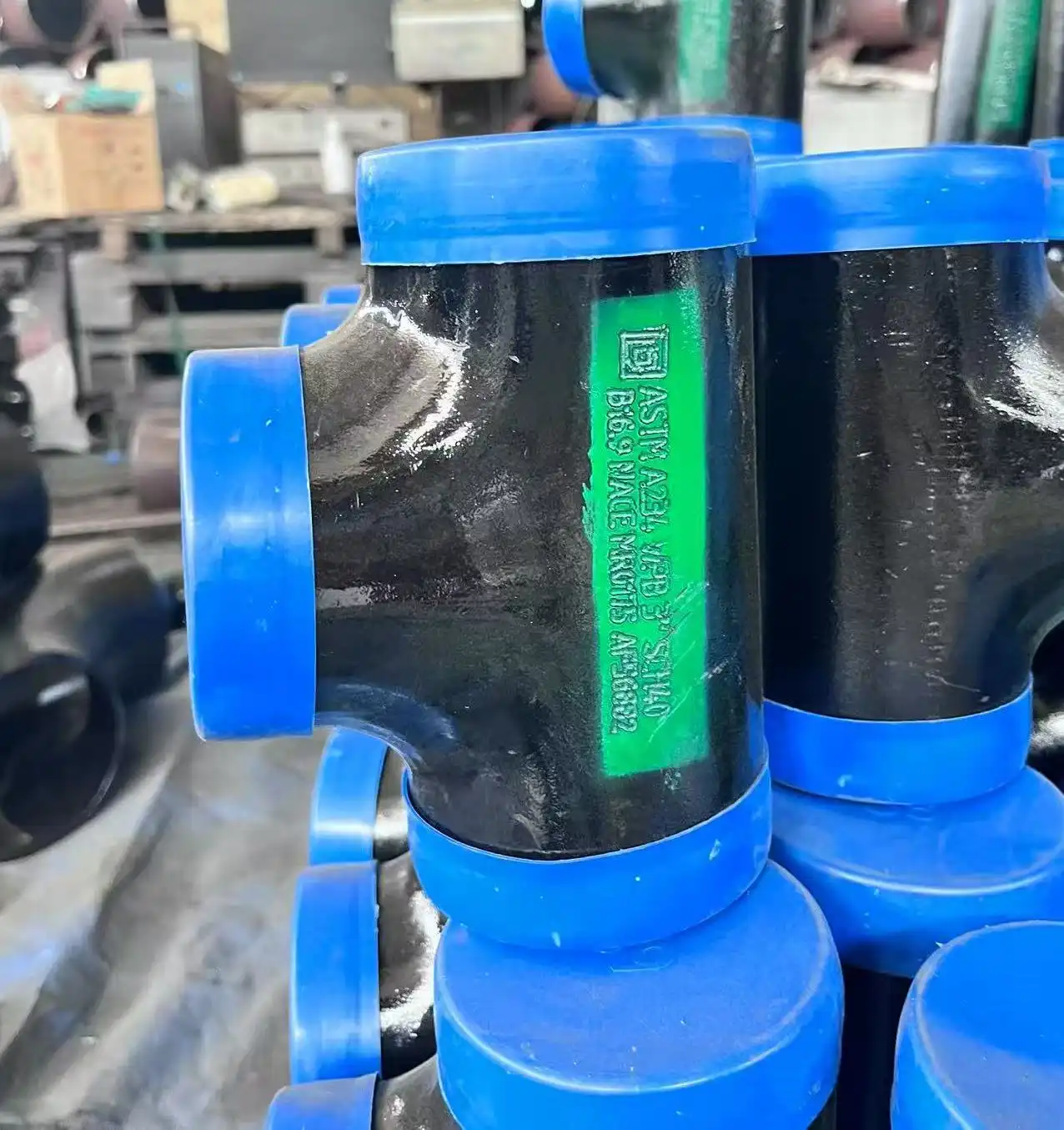
The applicable standards depend on the pipeline, fitting type, connection method, and project specification. Barred tees may be associated with dimensional standards for butt-weld fittings as well as pipeline design codes and owner-specific specifications. For example, some suppliers identify ASME B16.9 and MSS SP-75 for tee dimensions, while pipeline systems may also be designed under codes such as ASME B31.4 or ASME B31.8 depending on the service.
The important point is that there is no single standard that automatically defines every aspect of a barred tee. The purchaser should establish the governing design code, fitting dimensional standard, material specification, pressure and temperature requirements, and inspection requirements before production begins.
Inspection and Pig Gauging
Quality verification should extend beyond visual inspection. Depending on the project specification, manufacturers may be required to perform dimensional inspection, non-destructive examination, hydrostatic testing, material verification, weld inspection, and pig gauging.
Pig gauging is particularly relevant because the final product must provide a usable internal passage. A specification may require a gauge plate or gauging pig to pass through the main run without sticking or damaging the fitting. This provides a more meaningful verification of the barred tee's internal geometry than simply checking the outside dimensions.
For critical pipeline projects, buyers should also request the relevant material certificates, inspection records, welding documentation, test reports, and dimensional records. These documents help connect the delivered fitting with the engineering requirements established during procurement.
Barred Tee vs. Standard Tee: Which One Should You Choose?
A standard tee may be entirely appropriate when the piping system does not require pigging or when the branch configuration does not create a meaningful risk of pig entry. There is no reason to specify a barred design simply because it is considered a more specialized fitting.
The decision changes when a pipeline must accommodate cleaning or inspection pigs and the branch is large enough to provide an alternative path. In that situation, the internal bars of a barred tee provide a practical means of keeping the pig in the main run. The fitting becomes part of the overall pigging strategy rather than just another branch connection.
This also explains why barred tees should not be selected primarily on the basis of claims about pressure reduction, noise control, or generalized energy savings. Their value is much more specific: they help maintain a predictable pigging path through a branched pipeline. The fitting still has to satisfy the normal requirements for pressure containment, material compatibility, dimensional accuracy, and fabrication quality, but those requirements should not be confused with the fundamental purpose of the bars.
How Can Buyers Specify a Barred Tee More Effectively?
A useful purchasing specification should begin with the actual operating scenario. The manufacturer should understand the pipeline size, branch size, design pressure, design temperature, fluid service, material grade, pig type, pig dimensions, flow direction, and whether the pipeline will be pigged in one direction or both directions.
It is also helpful to clarify the required connection type, applicable standards, inspection scope, testing requirements, documentation, and any special coating or corrosion-control requirements. For offshore or highly demanding pipeline applications, additional engineering verification may be necessary because installation loads, cyclic service, corrosion conditions, and long-term integrity can affect the fitting design.
For manufacturers, these details provide the basis for determining the tee configuration and internal bar arrangement. For buyers, providing complete project information at the quotation stage reduces the risk of receiving a fitting that meets nominal dimensional requirements but does not work properly with the intended pigging system.
Conclusion
A barred tee is best understood as a pigging-oriented branch fitting rather than a general flow-control device. Its internal bars are designed to prevent cleaning or inspection pigs from entering a branch connection while allowing the pig to continue through the main pipeline. This makes barred tees particularly useful in piggable oil and gas pipelines and other branched systems where maintaining a reliable pigging path is essential.
Choosing the right fitting requires more than confirming the tee size. Main and branch dimensions, pig geometry, clearance, material compatibility, welding, design conditions, applicable codes, and inspection requirements should all be reviewed before production. When these factors are properly matched, a barred tee can become an important part of a reliable pipeline pigging system. For projects requiring customized dimensions, materials, pressure ratings, or inspection documentation, Cangzhou Oudi Pipe Manufacture Co., Ltd. can be positioned as a supplier capable of discussing the fitting requirements against the specific pipeline application.
With a commitment to quality and innovation, Oudi has been a trusted name in the piping industry since 1998. For more information or to discuss your specific piping needs, please contact us at oudi-04@oudiguandao.com.
References
1. Smith, J. A. (2019). Advanced Piping Design: Optimizing Flow with Barred Tees. Journal of Industrial Engineering, 45(3), 78-92.
2. Johnson, R. B., & Thompson, L. M. (2020). Comparative Analysis of Standard and Barred Tee Performance in High-Pressure Systems. International Journal of Fluid Dynamics, 12(2), 145-160.
3. Chen, Y., & Davis, K. L. (2018). Applications of Barred Tees in Multi-Phase Flow Separation. Chemical Engineering Progress, 114(8), 56-64.
4. Williams, E. F. (2021). Energy Efficiency Improvements in Industrial Piping Systems: The Role of Barred Tees. Energy & Fuels, 35(6), 5123-5135.
5. Anderson, P. R., & Miller, S. J. (2017). Safety Considerations in High-Pressure Piping: Advantages of Barred Tee Fittings. Process Safety Progress, 36(4), 380-392.
6. Lee, H. K., & Brown, T. A. (2022). Customization and Optimization of Barred Tees for Specific Industrial Applications. Industrial & Engineering Chemistry Research, 61(15), 5678-5690.

Need help finding the right solution with our experts. Please contact us.
SINCE 1998 Your Reliable Pipeline Manufacturer