What Does WPB Mean in ASTM A234 WPB Tee Specification?
When engineers, contractors, and purchasing teams see an ASTM A234 WPB Tee on a piping specification, the letters “WPB” are more than a simple product code. They identify a particular wrought carbon steel grade covered by ASTM A234/A234M, a specification used for piping fittings intended for pressure service at moderate and elevated temperatures. So whether you are evaluating a design or creating a purchase order or verifying a material test certificate or comparing various carbon steel fittings, it is crucial to know what WPB signifies. WPB might be misleading, since it is frequently mistakenly referred to as “Weldable Pipe Grade B.” WPB is more properly a wrought pressure classification of Grade B in engineering practice. But it’s not only the material quality that identifies the fitting. A full specification may also include dimensional standards such as ASME B16.9, nominal pipe size, wall thickness or schedule, fitting type, end preparation, heat treatment, inspection requirements and documentation. Material and production criteria are provided in ASTM A234 . Dimensional requirements for a standard butt-welding tee are often assessed in conjunction with the corresponding ASME fitting standard .
Understanding the WPB Designation in ASTM A234
What the Letters W, P, and B Indicate?
First, to clear up a widespread misconception, “WPB” does not mean “Weldable Pipe Grade B.” ASTM A234 is a standard for wrought carbon steel and alloy steel fittings for pressure pipe and pressure vessel construction and WPB is one of the most often used carbon steel grades in this specification.
The “W” is related to the language of wrought or weldable material and “P” is related to pressure service. The last “B” indicates the grade. ASTM A234 WPB is not a different kind of pipe, but rather a carbon steel fitting material grade used for pressure piping purposes. WPB is widely referred to as the typical carbon steel grade for butt-welding fittings such as elbows, tees, reducers and caps in the industry.
This difference is important when you are reading a buy spec. An ASTM A234 WPB tee is a fitting manufactured according to the A234 material standard. That does not imply the tee itself is a pipe-to-pipe standard such as ASTM A106. For a project, A106 Grade B pipe may be used with A234 WPB fittings, however they are two separate specifications.
Why WPB Is Widely Used for Carbon Steel Tees?
WPB is often specified because it offers a convenient mix of strength, formability, weldability and availability for many standard carbon steel pipe systems. ASTM A234 specifies the chemical and mechanical properties and offers engineers and customers a specific material base instead of a manufacturer’s general description such as “carbon steel tee.”
This grade is extensively used in refinery, petrochemical, power generation, process piping and other industrial systems where carbon steel fittings are suited for the service conditions. WPB fittings are rather ubiquitous and hence come in many common sizes and combinations , making them quite easy to find for typical pipe applications .
“Widely used” should not be taken to suggest that WPB is necessarily fit for every high pressure or high temperature application. Design pressure, design temperature, fluid, corrosion conditions, pipe code, wall thickness, method of connecting, and project-specific criteria must still be considered in the choice of material.
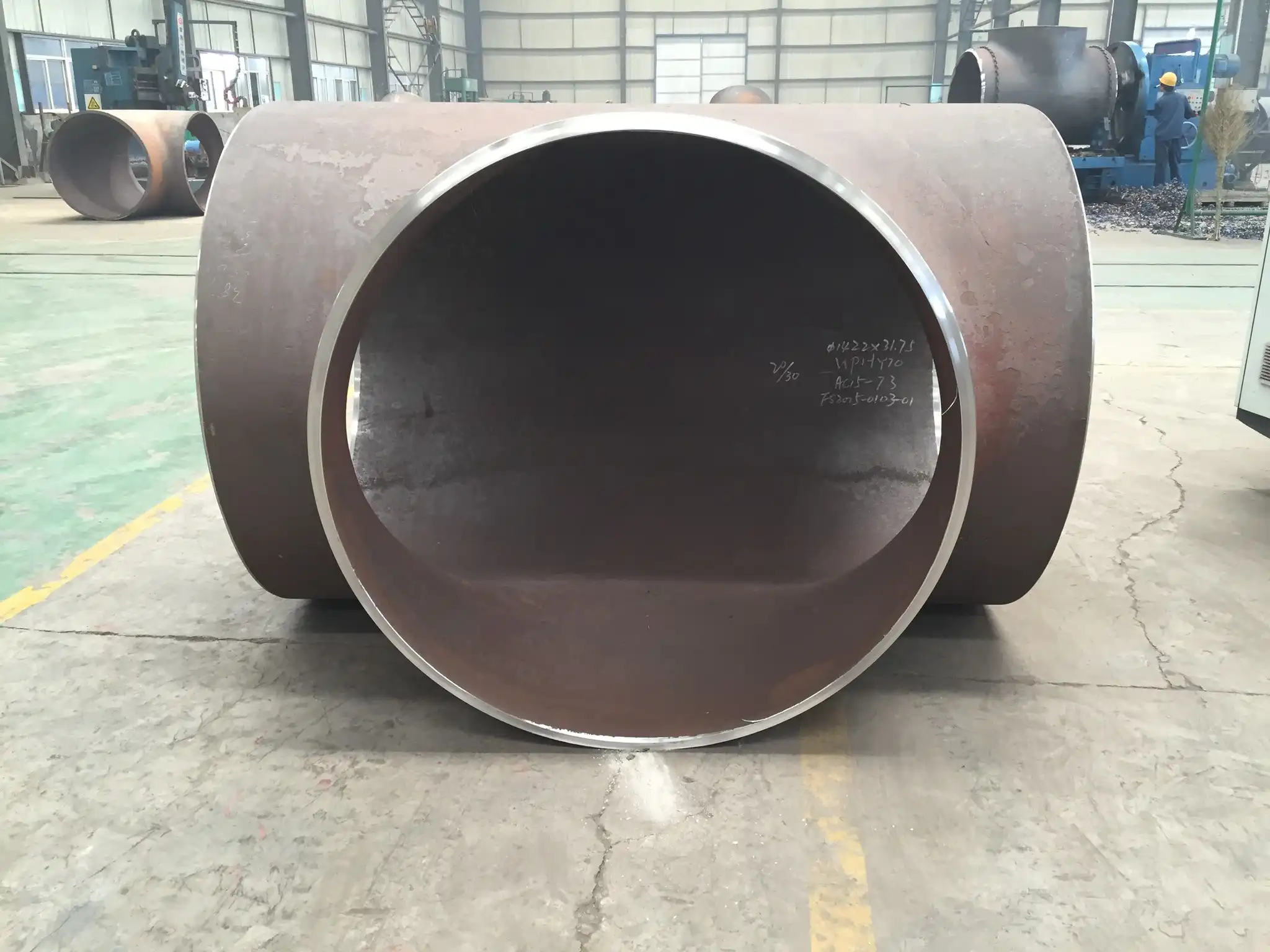
ASTM A234 WPB Tee Chemical Composition
Carbon and Manganese Requirements
The chemical composition of WPB is managed as the balance of carbon and other elements influences strength, manufacturing behaviour, and material uniformity. Existing citations of ASTM A234/A234M show a maximum carbon content of 0.30% for WPB, with manganese regulated between about 0.29% and 1.06%. Maximum limitations are laid forth for phosphorus and sulphur and a minimum defined concentration of silicon.
Carbon is one to pay special attention to, since more carbon might mean more strength and hardness, but can also influence weldability. Hence, it is vital to maintain the appropriate chemical balance for a carbon steel fitting to be welded into a pipe system. The WPB chemical standards do not just exist to strengthen the fitting; they define a uniform material grade that can be produced and tested to a known specification.
Manganese adds to the strength and metallurgical properties of the steel, while silicon is utilised in steelmaking and assists in deoxidation, as reflected in specifications for an ASTM A234 WPB Tee. Phosphorus and sulphur are controlled because an excess might impair the quality of the material and the performance of manufacturing.
Minor Alloying Elements Should Not Be Misinterpreted
WPB is a carbon steel grade and the inclusion of regulated levels of chromium, nickel, copper, molybdenum or vanadium should not be construed as making the fitting equal to a chromium-molybdenum or stainless steel fitting. WPB is neither a corrosion resistant or high alloy material as per ASTM A234, it restricts these elements instead. For instance, the existing A234 / A234M data provide the maximum limits of chromium, molybdenum, nickel, copper and vanadium levels in WPB.
This is a key difference when comparing materials. For high temperature service, a project may need a Cr-Mo fitting, calling for grades such as WP11 or WP22 instead of WPB. Typically, stainless steel applications need a suitable ASTM A403 grade rather than A234 WPB. Therefore, material selection should be based on technical specification rather than the assumption all A234 grades would function similarly.
Mechanical Properties of ASTM A234 WPB Tee
Yield Strength and Tensile Strength
Mechanical properties provide another way to understand why WPB is widely used. ASTM A234 WPB is commonly specified with a minimum tensile strength of 60,000 psi, or approximately 415 MPa, and a minimum yield strength of 35,000 psi, or approximately 240 MPa. These values establish minimum strength requirements for the grade and help engineers evaluate whether the material is appropriate for the intended piping service.
Yield strength describes the stress level associated with the onset of permanent deformation, while tensile strength represents the maximum stress reached during a tensile test before fracture. These figures should not be interpreted as the allowable operating stress of a tee. The allowable stress used for piping design depends on the applicable design code, temperature, material condition, wall thickness, and other engineering factors.
This distinction is especially important for buyers. Seeing “60,000 psi tensile strength” on a material datasheet does not mean that a WPB tee can simply be installed in a system operating at 60,000 psi. The fitting's pressure capability must be evaluated within the complete piping design, including pipe wall thickness, fitting dimensions, temperature, connection details, and applicable code requirements.
Elongation and Material Ductility
Elongation provides information about the ductility of the steel. A ductile carbon steel fitting can undergo a degree of plastic deformation during mechanical testing before fracture, which is an important characteristic for components that must be formed, welded, and incorporated into piping systems.
The original article's statement that WPB universally has “30% elongation in 2 inches” is too broad. ASTM A234 mechanical requirements depend on the applicable test specimen and direction, and published A234 WPB data commonly show different minimum elongation values for longitudinal and transverse round specimens. One current industry datasheet, for example, lists 22% longitudinal and 14% transverse elongation for WPB/WPC mechanical requirements.
For that reason, a technical article should avoid presenting one simplified elongation number as if it were the only requirement. When a project has specific mechanical testing requirements, the purchaser should review the applicable edition of ASTM A234/A234M and the material certificate supplied with the fitting.
Hardness and Impact Testing Need Context
Hardness is another property that may appear in inspection documentation, but it should not be used alone to define the overall performance of an ASTM A234 WPB Tee. Hardness limits and testing requirements can depend on the grade, heat treatment, product condition, and applicable specification requirements.
The same caution applies to impact testing. It is not accurate to describe every WPB tee as having a particular guaranteed impact resistance simply because it is manufactured from carbon steel. Additional impact testing can be required by a project specification, piping code, service condition, or supplementary requirement. The relevant test temperature and acceptance criteria must therefore be checked against the actual purchasing specification rather than inferred from the WPB designation alone.
How Manufacturing Affects a WPB Tee?
Forming and Heat Treatment
ASTM A234 allows fittings to be produced through specified forming and shaping processes, and the manufacturing route can include operations such as forging, pressing, bending, rolling, or other suitable forming methods. The purpose is to produce a fitting without harmful imperfections while achieving the required material properties and dimensions.
For a tee, manufacturing control is particularly important because the fitting has a branch connection that must maintain suitable geometry and material integrity. An equal tee has the same nominal run and branch size, while a reducing tee connects a smaller branch to a larger run. In both cases, the finished geometry has to match the piping layout and the corresponding welding connection.
Heat treatment requirements also matter because thermal processing can affect the material's microstructure and mechanical properties. Depending on the fitting size, grade, and manufacturing route, ASTM A234 contains requirements concerning heat treatment. A supplier should therefore be able to identify the applicable heat-treatment condition and provide supporting documentation when required by the purchase specification.
Why Material Traceability Matters?
For industrial projects, purchasing an ASTM A234 WPB Tee should involve more than confirming that the product is labeled “WPB.” Traceability is important because the material needs to be connected to the relevant heat or production record, inspection results, and certification.
A material test certificate can provide useful information such as the chemical analysis, mechanical test results, heat number, material grade, dimensions, and applicable standard. For projects requiring formal inspection documentation, buyers should make sure the certificate type and inspection requirements are agreed upon before production rather than after the fittings have been delivered.
This is particularly relevant for large projects where fittings such as an ASTM A234 WPB Tee may be installed across multiple piping systems. Clear marking and documentation make it easier to verify that the material supplied matches the engineering specification and purchase order.
ASTM A234 WPB Tee and ASME B16.9 Are Not the Same Requirement
Material Grade Versus Fitting Dimensions
One of the most important points for buyers is the difference between the material specification and the dimensional specification. ASTM A234 WPB identifies the fitting material and associated requirements, while ASME B16.9 is commonly used for factory-made wrought butt-welding fittings and establishes dimensional requirements for fittings such as tees.
For example, a purchasing description might specify an ASTM A234 WPB tee manufactured to ASME B16.9, together with the required nominal pipe size and wall thickness. A product listing for an A234 WPB tee can therefore show both the A234 material designation and the B16.9 dimensional standard.
This distinction prevents a common purchasing mistake. Specifying only “WPB tee” may not provide enough information for a manufacturer to determine the complete product requirement. The supplier may also need the NPS, equal or reducing configuration, schedule or wall thickness, end preparation, applicable dimensional standard, quantity, inspection requirements, and documentation requirements.
Equal Tees and Reducing Tees
An equal tee has the same nominal size for the run and branch, while a reducing tee has different nominal sizes. Both configurations can be manufactured in ASTM A234 WPB, but the dimensional requirements are not interchangeable.
ASME B16.9 dimensions are related to the nominal size and fitting configuration, while wall thickness is determined separately according to the specified schedule or design requirement. This is why a buyer should not assume that a tee's material grade determines its complete dimensions. The material and dimensional requirements need to be stated together in a proper purchase specification.
Conclusion
The “WPB” in ASTM A234 WPB Tee is a material grade designation associated with wrought carbon steel pressure piping fittings. It should not simply be expanded as “Weldable Pipe Grade B.” A more accurate engineering interpretation relates WPB to wrought pressure Grade B, with the material requirements defined by ASTM A234/A234M. The grade has controlled chemical composition and specified mechanical requirements, including minimum tensile and yield strength values, while the exact testing and certification requirements depend on the applicable standard and project specification.
For anyone purchasing or specifying an ASTM A234 WPB Tee, the material designation is only part of the requirement. The tee's size, configuration, wall thickness, dimensions, manufacturing condition, inspection requirements, and documentation should also be clearly defined. ASME B16.9 may be relevant to the fitting's dimensional requirements, while ASTM A234 establishes the material specification. Keeping these requirements separate but coordinated helps prevent specification errors and makes communication between the manufacturer and purchaser much clearer.
Since 1998, Cangzhou Oudi Pipe Manufacture Co., Ltd. has focused on the production of carbon steel pipe fittings, valves, and flanges in China. Located in Mengcun Hui Autonomous County, a well-known pipe fitting manufacturing area, the company operates a 66,600-square-meter facility and supplies fittings manufactured to American, Japanese, German, and British standards. Its reported annual production capacity reaches 16,000 tons, supporting applications that require a broad range of industrial piping components. For buyers evaluating WPB tees, the most useful next step is to provide the required material standard, fitting dimensions, size, wall thickness, quantity, inspection requirements, and documentation requirements so the manufacturer can confirm the exact product configuration before production. For more information or inquiries, please contact us at oudi-04@oudiguandao.com.
FAQ
1. What does WPB stand for in ASTM A234 WPB Tee?
WPB stands for "Weldable Pipe Grade B" in ASTM A234 WPB Tee specifications.
2. What are the key chemical composition requirements for WPB grade?
WPB grade requires a maximum carbon content of 0.30%, along with controlled amounts of manganese, phosphorus, sulfur, and silicon.
3. How does the WPB grade affect the mechanical properties of ASTM A234 Tees?
The WPB grade ensures high tensile and yield strength, good ductility, and a balance between hardness and impact resistance in ASTM A234 Tees.
4. What are the typical applications for ASTM A234 WPB Tees?
ASTM A234 WPB Tees are commonly used in high-pressure and high-temperature piping systems in industries such as oil and gas, petrochemical, and power generation.
References
1. ASTM International. (2019). ASTM A234/A234M-19 Standard Specification for Piping Fittings of Wrought Carbon Steel and Alloy Steel for Moderate and High Temperature Service.
2. American Society of Mechanical Engineers. (2019). ASME B16.9-2018 Factory-Made Wrought Buttwelding Fittings.
3. Nayyar, M. L. (2000). Piping Handbook (7th ed.). McGraw-Hill Education.
4. Smith, P. (2018). Piping Materials Guide: Selection and Applications. Elsevier.
5. Antaki, G. A. (2003). Piping and Pipeline Engineering: Design, Construction, Maintenance, Integrity, and Repair. CRC Press.
6. American Petroleum Institute. (2016). API Specification 5L: Specification for Line Pipe (46th ed.).

Need help finding the right solution with our experts. Please contact us.

SINCE 1998 Your Reliable Pipeline Manufacturer



