A Complete Guide to ASTM A234 WPB Tee Standards
In industrial piping, a tee is more than a simple branch fitting. Its dimensions, material grade, wall thickness, manufacturing route, and inspection records all have to match the requirements of the piping system in which it will be installed. For carbon steel applications, the ASTM A234 WPB Tee is a commonly specified butt welding fitting for pressure piping and elevated temperature service. ASTM A234 and ASME B16.9 are different parts of the standard. ASTM A234/A234M covers wrought carbon steel and alloy steel fittings for chemical composition, mechanical qualities, and requirements for production and heat treatment. ASME B16.9, however, covers wrought factory-made butt welding fittings for dimensions, tolerances, ratings, testing, and marking. Understanding the distinction between the two standards is vital when writing a buy spec or evaluating a manufacturer’s documentation. This information assists engineers, procurement teams, inspectors, and pipe contractors to choose the correct fitting and to identify abnormalities before installation. The following section outlines the critical considerations in specifying and assessing an ASTM A234 WPB Tee.
Understanding ASTM A234 WPB Tee Material Requirements
What ASTM A234 WPB Means?
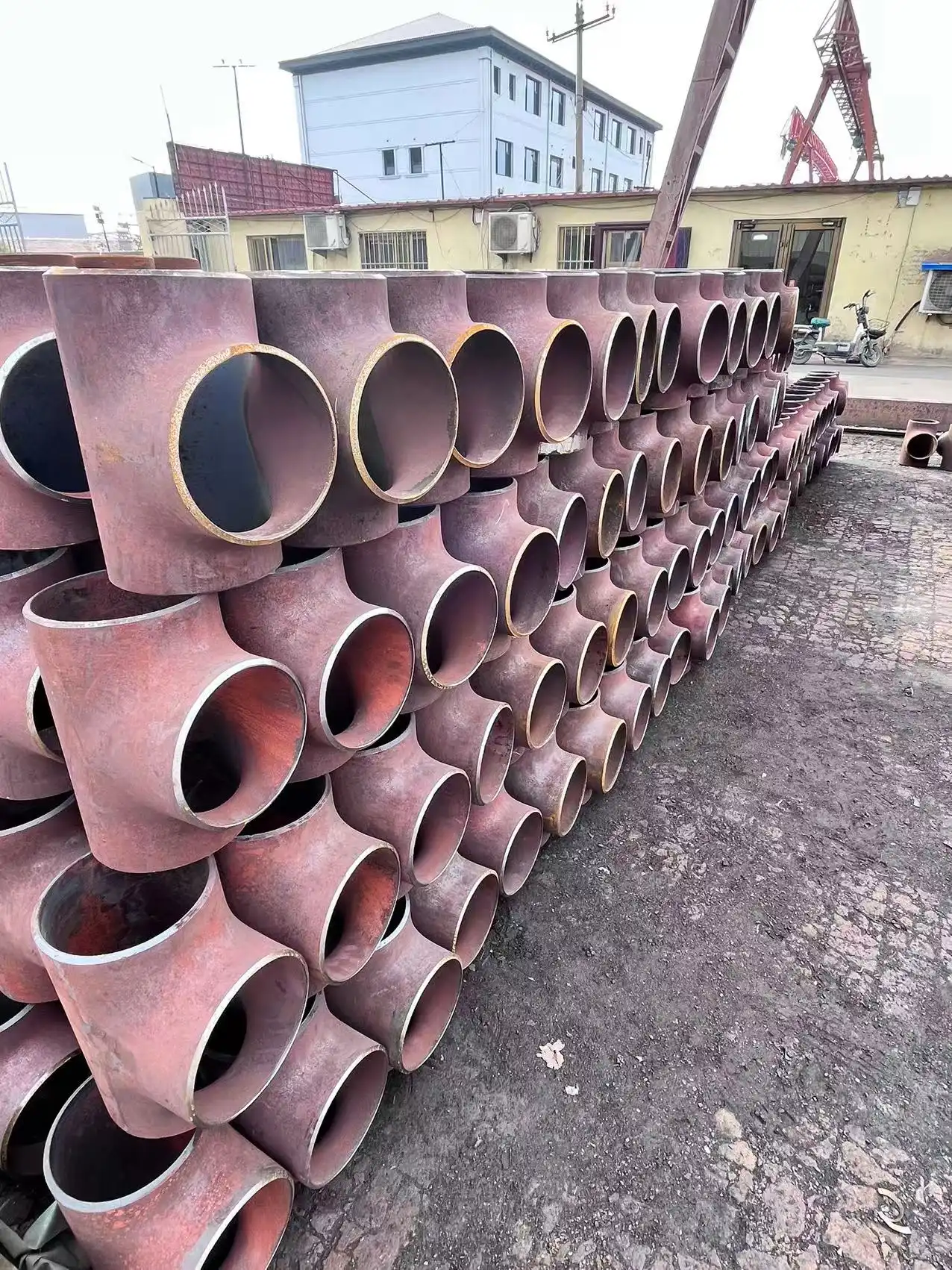
ASTM A234 WPB is a type of wrought carbon steel fitting used in pressure pipe and related pressure service applications. The “WPB” label identifies the material grade, and the tee indicates the fitting geometry. A tee generally has one branch out at around 90 degrees to the mainline. This allows a pipe system to either split or combine flow.
Material standard is not the same as dimension standard. The factory-produced butt welding fittings are manufactured to ASTM A234 material and production requirements, and the dimensional specifications are specified by ASME B16.9. A correctly specified tee will have an identifier comprising ASTM A234 WPB, ASME B16.9, NPS size, and schedule or nominal wall thickness.
This difference is especially crucial for the case of purchase. Simply asking for an "ASTM A234 WPB Tee” may not provide a manufacturer with enough information to understand exactly what product you want. The buyer may also have to state whether the fitting is to be a straight tee or reducing tee, the lengths of the run and branch, wall thickness or schedule, end preparation, quantity, inspection requirements, and paperwork required.
Chemical Composition of WPB
The chemical composition of WPB is managed since the strength, toughness, weldability, and behavior of the material during manufacture are all influenced by carbon, manganese, phosphorus, sulfur, and silicon. Common criteria for WPB are carbon max 0.30%, manganese 0.29% to 1.06%, phosphorus max 0.050%, sulfur max 0.058%, and silicon min 0.10%.
These values are not meant to provide a generic description of all carbon steel fittings. The exact chemical requirements are contained in the applicable ASTM A234/A234M and the purchase specification. The material test certificate is especially crucial since it provides exact chemical analysis and not only a notional grade identification.
It may also allow procurement teams to avoid material substitution by confirming the chemistry against the right material grade. If the material certificate does not match the grade or heat needed, it is not appropriate just because it fits nicely on the exterior.
Mechanical Properties and What They Mean in Service
ASTM A234 WPB minimum tensile strength is 60 ksi, or roughly 415 MPa. Minimum yield strength is 35 ksi, or about 240 MPa. So the minimum elongation is 22% instead of 30%, as mentioned in the first edition of this article.
These figures represent the mechanical characteristics of the material under certain test circumstances. These are not a completed tee with a universal working pressure or temperature rating. The actual permissible pressure and temperature are determined by the size of the fitting, wall thickness, design code, qualities of the material, circumstances of connection, and the whole pipe system.
This is a crucial difference from an engineering standpoint. A WPB tee meeting the material standards for a given service does not entail that every size, schedule, and configuration of WPB tee is qualified for that service. The fitting will be examined as part of the whole pipe design.
How ASME B16.9 Applies to ASTM A234 WPB Tee Dimensions?
NPS, Outside Diameter, and Wall Thickness
ASME B16.9 covers factory-made wrought butt welding fittings and provides dimensional requirements for fittings from NPS 1/2 through NPS 48. It covers fittings with different producible wall thicknesses, so the nominal pipe size should not be treated as the complete dimensional specification.
For example, a 6 in. NPS fitting has an outside diameter associated with the NPS designation, but its wall thickness still depends on the specified schedule or nominal wall thickness. This is why describing a 6-in. tee as having one universal “standard wall thickness” can be misleading.
When ordering an ASTM A234 WPB Tee, the buyer should therefore identify the run size, branch size, and wall thickness or schedule. For a reducing tee, the branch dimension must be specified separately from the run. The manufacturer's drawing or dimensional standard should then be checked before production if the connection has tight installation constraints.
Centre to End Dimensions and Branch Geometry
The centre-to-end dimensions of a tee affect how the fitting connects to adjoining pipe and how much space is required inside the piping layout. These dimensions are especially important when replacing an existing fitting because even a relatively small dimensional difference can create alignment problems during installation.
For new construction, the fitting dimensions should be checked against the piping isometric, spool drawing, and applicable standard. For maintenance work, it is also useful to confirm the existing pipe outside diameter and wall thickness rather than selecting a replacement only by nominal size.
The branch geometry deserves similar attention. A straight tee has the same nominal size on the run and branch, while a reducing tee has different sizes. These configurations are not interchangeable simply because the material grade is identical.
Tolerances and End Preparation
ASME B16.9 defines dimensional tolerances and requirements for butt welding fittings. Wall thickness, for example, is subject to minimum thickness requirements rather than simply being treated as an exact nominal value. The current standard specifies minimum wall thickness provisions and addresses other dimensional tolerances through its dimensional tables.
The welding ends also require attention because the preparation must be compatible with the adjoining pipe and the applicable welding procedure. In a real installation, the fitting is not evaluated only by its overall appearance. The bevel, end dimensions, wall thickness, and alignment all influence whether the tee can be properly welded into the piping system.
For this reason, dimensional inspection should be based on the applicable standard and the approved purchase specification rather than on a general assumption that all tees of the same NPS are identical.
Manufacturing and Heat Treatment of WPB Tees
Forming Methods Influence Heat Treatment
One of the areas where the original article was too general is heat treatment. ASTM A234 does not simply require every WPB fitting to receive the same normalising treatment.
The required condition can depend on how the fitting is formed and at what temperature the final forming operation is completed. For example, ASTM A234 provisions distinguish between hot-formed and cold-formed WPB fittings and establish different requirements for particular manufacturing conditions. Certain hot-formed WPB fittings completed within specified temperature ranges and cooled appropriately may not require additional heat treatment, while other forming conditions can require annealing, normalising, or normalised and tempered treatment.
This is why a manufacturer's heat treatment record can be more informative than a generic statement such as “all WPB tees are normalised." The actual production route should be consistent with the applicable edition of ASTM A234/A234M and the purchaser's requirements.
Quality Control Should Match the Specification
Quality control for an ASTM A234 WPB Tee can include dimensional inspection, material verification, visual examination, mechanical testing, hardness checks where applicable, and other examinations required by the governing specification or purchase order.
Nondestructive examination should not automatically be presented as a mandatory UT or RT requirement for every WPB tee. The required examination depends on the applicable standard, manufacturing method, purchaser requirements, supplementary requirements, and project specification. ASME B16.9 also has its own provisions concerning testing and does not make hydrostatic testing of every wrought fitting a blanket requirement.
For project procurement, it is therefore better to state the exact inspection level in the purchase order. If the project requires additional NDE, third-party inspection, PMI, hardness testing, or specific certification, these requirements should be agreed upon before production rather than assumed after the fittings have been manufactured.
Marking, Traceability, and Documentation
What Should Be Checked on the Fitting?
Marking provides a practical connection between the physical fitting and its manufacturing documentation. ASME B16.9 requires standard markings to identify the manufacturer or trademark, material identification, wall thickness or schedule, nominal pipe size, and applicable compliance information.
For an ASTM A234 WPB Tee, these markings should be legible and consistent with the purchase order and material documentation. If the fitting carries a heat number or other traceability identification, that information can be used to connect the physical product with the corresponding material test certificate.
This becomes particularly useful when fittings are delivered in large quantities. A warehouse may contain several carbon steel fittings with similar dimensions, and traceable marking reduces the possibility of mixing materials or sizes during fabrication.
Reviewing the Material Test Certificate
The material test certificate should be reviewed alongside the fitting itself. Procurement and QA personnel can compare the material designation, heat number, chemical analysis, mechanical test results, dimensions, and stated standards with the purchase requirements.
The goal is not simply to collect paperwork. The documentation should demonstrate that the delivered fitting corresponds to what was actually ordered. If the purchase order specifies ASTM A234 WPB and ASME B16.9, the supporting documentation should allow the purchaser to verify those requirements without relying only on the manufacturer's product description.
Where ASTM A234 WPB Tees Are Commonly Used?
Process and Petrochemical Piping
Carbon steel butt welding tees are widely used in process piping where the material grade and design conditions are appropriate. In refinery and petrochemical systems, a tee can provide a branch connection for process lines, utility services, or other piping arrangements.
The suitability of WPB depends on the actual process conditions. Carbon steel should not automatically be described as corrosion resistant simply because it has adequate mechanical strength. If the process fluid is particularly corrosive, the engineer may need to consider corrosion allowance, internal lining, material upgrades, or another corrosion control strategy.
This makes material selection a design decision rather than a simple matter of choosing a commonly used fitting grade.
Power and Utility Systems
ASTM A234 WPB fittings can also be specified in industrial utility and power-related piping where their material properties and design conditions are appropriate. Steam, condensate, water, compressed air, fuel, and other utility systems may contain butt welding tees, although the correct material and design rating depend on the individual service.
Thermal cycling is also worth considering. A fitting may experience repeated heating and cooling during plant startup, shutdown, or process changes. The piping engineer therefore needs to evaluate the complete system, including thermal expansion, stresses, support arrangements, and weld details, rather than treating the fitting material alone as the determining factor.
Oil and Gas Piping
In oil and gas facilities, WPB tees may be used in process and utility piping when the material is compatible with the service conditions and project specifications. They can appear in gathering, processing, transmission, and plant piping systems where butt welding provides a permanent connection.
However, the term “oil and gas application” covers a very broad range of environments. Onshore process piping, offshore facilities, sour service, high-pressure gas systems, and subsea systems can have very different material requirements. A standard ASTM A234 WPB designation should therefore not be presented as universally suitable for all oil and gas applications.
For sour service or other demanding environments, additional material and design requirements may apply. The engineer should follow the governing project specification and applicable piping code before selecting the fitting.
Conclusion
ASTM A234 WPB Tee fittings are widely used carbon steel butt welding components for pressure piping and elevated temperature service when their material, dimensions, and design conditions are appropriate. The key to specifying them correctly is understanding that ASTM A234 and ASME B16.9 serve different purposes. ASTM A234 establishes requirements related to the fitting material and manufacturing, while ASME B16.9 addresses the dimensions, tolerances, markings, testing, and other requirements associated with factory-made butt welding fittings.
For engineers and procurement teams, the most important considerations extend beyond the words “ASTM A234 WPB". The fitting configuration, NPS, wall thickness or schedule, manufacturing route, heat treatment condition, inspection requirements, marking, and material documentation should all be consistent with the project specification. It is equally important not to assume that WPB provides corrosion resistance or that every fitting requires the same heat treatment and nondestructive examination.
A well-specified tee reduces uncertainty before fabrication and makes material verification easier after delivery. When the material certificate, physical marking, dimensions, and inspection records all tell the same story, the fitting can be incorporated into the piping system with much greater confidence.
For more information about ASTM A234 WPB Tee fittings and other high-quality piping components, please contact Cangzhou Oudi Pipe Manufacture Co., Ltd. at oudi-04@oudiguandao.com. As a leading manufacturer of carbon steel pipe fittings, valves, and flanges since 1998, we are committed to providing superior products and excellent service to customers worldwide.
FAQ
1. What is the maximum operating temperature for ASTM A234 WPB Tee fittings?
ASTM A234 WPB Tee fittings can operate at temperatures up to 650°F (343°C).
2. Are ASTM A234 WPB Tee fittings suitable for cryogenic applications?
While they can be used at temperatures as low as -20°F (-29°C), ASTM A234 WPB Tee fittings are not typically recommended for cryogenic applications.
3. What is the difference between ASTM A234 WPB and WPC grades?
ASTM A234 WPB has a higher carbon content and is suitable for higher temperature applications compared to WPC grade.
4. Can ASTM A234 WPB tee fittings be welded?
Yes, ASTM A234 WPB Tee fittings are suitable for welding and are commonly joined using various welding techniques.
References
1. ASTM International. (2019). ASTM A234/A234M-19 Standard Specification for Piping Fittings of Wrought Carbon Steel and Alloy Steel for Moderate and High Temperature Service.
2. American Society of Mechanical Engineers. (2018). ASME B16.9-2018 Factory-Made Wrought Buttwelding Fittings.
3. Nayyar, M. L. (2000). Piping Handbook (7th ed.). McGraw-Hill Education.
4. Smith, P. (2018). Piping Materials Guide: Selection and Applications for Process Plants. Elsevier.
5. American Petroleum Institute. (2016). API Specification 5L: Specification for Line Pipe (46th ed.).
6. Antaki, G. A. (2003). Piping and Pipeline Engineering: Design, Construction, Maintenance, Integrity, and Repair. CRC Press.

Need help finding the right solution with our experts. Please contact us.

SINCE 1998 Your Reliable Pipeline Manufacturer



