Carbon Steel Elbow vs Carbon Steel Bend: What’s the Difference?
In industrial piping systems, changing the direction of a pipeline requires more than simply choosing a fitting with the correct angle. Carbon steel elbows and carbon steel bends can both redirect a pipe, but they are not always interchangeable. They might vary in terms of shape, manner of production, dimensional standards, installation space, flow behaviour, and the circumstances in which the pipe system will work. This difference is especially essential when a project includes long-distance pipelines, process pipes, oil and gas transportation, power generation, or other systems where pressure loss and mechanical loads must be carefully regulated. In a situation where the layout enables a little change in direction, an elbow may be more practical. A bigger radius bend may be more beneficial if the pipe design allows for a smoother transition. It’s also vital not to refer to the distinction as “forged elbow versus bent pipe.” Common butt-welding elbows have specifications such as ASME B16.9, and factory-manufactured induction bends have their own criteria under ASME B16.49. The actual production path is dictated by product type, size, material, appropriate standard, and project specification. Knowing the differences between them can help you choose a part based on engineering needs rather than just looks or words.
Understanding the Basic Difference Between an Elbow and a Bend
Geometry is the most helpful beginning point. Both components alter the direction of a pipeline, but the radius through which the pipe changes direction is typically different.
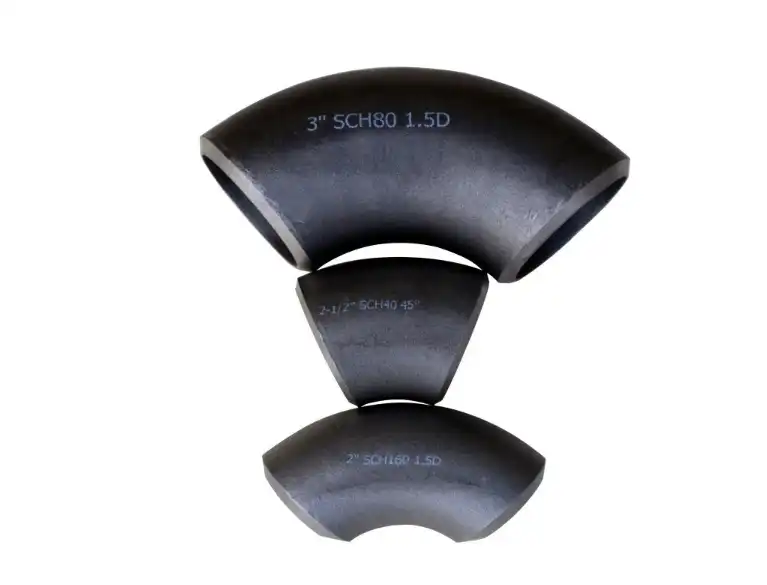
Generally, the carbon steel elbow is a short pipe fitting that is produced with a certain angle and radius. 45° and 90° elbows are standard designs; however, different angles may be manufactured for particular purposes. Butt-welding elbows are often used in process and industrial pipes, since their standardised dimensions make them easy to specify and connect to other components.
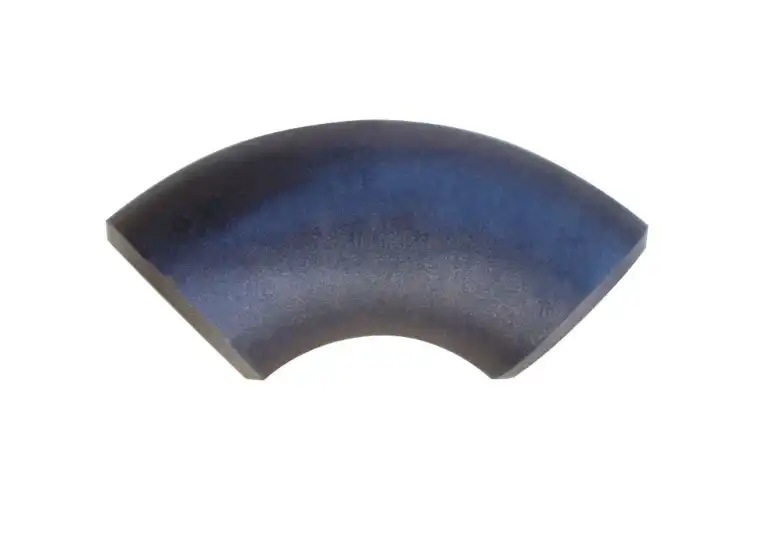
A carbon steel bend usually means a curved pipe piece with a higher bending radius. In many pipeline applications, the bends are obtained by creating a pipe via a controlled bending operation. One significant example is induction bending. Localised heating enables the pipe to be shaped to a regulated radius during induction bending while the remainder of the pipe stays reasonably cold. ASME B16.49 covers wrought steel factory-made butt-welding induction bends intended for use in transportation and distribution systems.
This variation in radius has practical implications. An elbow may change a pipeline in a relatively short distance; a long-radius curve takes more physical area. In contrast, a bigger bend radius allows a more gradual shift in flow direction.
Thus, the phrases should be seen as technical descriptors rather than just two names for the same component.

How Manufacturing Methods Affect the Final Product?
How Carbon Steel Elbows Are Formed?
The procedure for making an elbow is based on product design and relevant standards. A typical butt-welding elbow is a wrought fitting rather than a forged fitting in the literal meaning of the word. Manufacturing may include pipe or tubular material creation by controlled heating and mechanical deformation, and subsequent heat treatment, sizing, machining, and inspection as needed by the relevant standard.
This difference is important since “wrought” and “forged” should not be used interchangeably in technical purchase papers. ASME B16.9 covers factory-built wrought carbon and alloy steel butt-welding fittings, including carbon steel elbows, while ASME B16.11 covers forged socket-welding and threaded fittings.
During manufacturing, manufacturers must regulate crucial factors such as wall thickness, ovality, dimensional tolerances, end preparation, heat treatment, and material qualities. These qualities influence the way the elbow is incorporated into the pipe system and whether it meets the design requirements of the project.
Saying just 'a forged elbow' is not as helpful for procurement reasons as specifying the needed standard, material grade, nominal pipe size, schedule or wall thickness, angle, radius and inspection requirements.
How Carbon Steel Bends Are Manufactured?
Depending on the diameter, wall thickness, bend radius, material, and application, carbon steel bends may be made via numerous forming processes.
Induction bends are especially essential for big pipe bends. The procedure involves localised heating of the pipe and mechanical force to move the pipe across a specified radius. This enables the production of bigger radius bends with control of the geometry and material behaviour.
Also, cold bending and hot bending are employed for distinct purposes. The choice of procedure relies on the material and dimensional requirements. Deformation must be carefully controlled by the producer, as bending may affect wall thickness, ovality, residual stresses, and the dimensional correctness of the completed product.
That's why it's not technically enough to state that an elbow is "forged" and a bend is "bent." Both goods may be subjected to forming processes, but their shape, production route, and relevant product standard might be extremely different.
Why Manufacturing Details Matter?
The manufacturing process impacts more than the look of the fitting. The circumstances during forming affect the final distribution of wall thickness, mechanical characteristics, dimensional correctness, and heat treatment needs.
Therefore, rather than assume one product is fundamentally stronger than the other, a customer should check the manufacturer's technical literature. The fitting must be an engineering component suited for the design circumstances as a whole for pressure piping.
An excellent illustration of why standards must be understood in the context of their scope is MSS SP-75. The existing SP-75-2025 specifies requirements for high-strength wrought butt-welding fittings manufactured of carbon and low-alloy steels for high-pressure gas and oil transmission and distribution systems. It covers the criteria for dimensions, ratings, testing, materials, heat treatment, inspection, certification, and marking.
Therefore, the applicable standard for carbon steel elbows should be chosen based on the actual product and service and not added to a specification merely because it is attached to carbon steel fittings.
How Bend Radius Influences Flow Through the Piping System?
Why a Larger Radius Can Change Flow Behavior?
Whenever fluid changes direction, the flow is disturbed. The severity of that disturbance depends partly on the geometry of the directional change.
A compact elbow forces the fluid to change direction over a relatively short distance. Depending on its radius and angle, this can generate secondary flow, turbulence, and a local pressure loss. A larger-radius bend provides a more gradual change in direction, which can reduce the intensity of these effects.
However, this does not mean that every carbon steel bend automatically provides lower pressure loss than every elbow. The actual result depends on the fitting geometry, bend radius, flow velocity, pipe diameter, fluid properties, and the configuration of the entire piping system.
For an engineer designing a high-flow system, the correct approach is to use appropriate loss coefficients or hydraulic calculations rather than selecting a fitting solely because it is called a bend.
Flow Considerations in Abrasive Service
The same principle applies to systems carrying particles or other potentially erosive materials. A sudden directional change can create localized areas where particles impact the pipe wall more intensely. A larger-radius bend can sometimes distribute the change in direction over a longer path and reduce severe local impingement.
Even so, erosion performance should not be generalized across all elbows and bends. Flow velocity, particle concentration, particle size, fluid density, bend radius, material properties, and operating conditions all influence actual wear.
For this reason, an application involving abrasive slurry, ash, mineral particles, or other solids should be evaluated according to its specific operating conditions. In demanding services, the design may also require additional wear allowance or specialized materials rather than relying only on a change from an elbow to a bend.
Installation Space Can Be Just as Important as Flow Performance
The physical layout of a plant or pipeline often determines whether an elbow or bend is practical.
A conventional elbow provides a directional change within a relatively compact area. This can be valuable around pumps, vessels, valves, heat exchangers, and other equipment where available space is limited. The standardized dimensions of many elbows also make them convenient for modular piping layouts.
A long-radius bend requires more room because the centerline travels through a larger arc. This can be a disadvantage in a congested process plant, but it can be an advantage in a long pipeline where there is sufficient space and reducing abrupt directional changes is important.
The installation method also matters. A bend may be useful when a project layout benefits from a longer, continuous curved section, while an elbow may simplify a more compact arrangement involving several standardized fittings.
This means that selection should not be based on pressure loss alone. Engineers should consider the available routing space, support arrangement, equipment location, welding access, transportation requirements, and maintenance access at the same time.
Standards Provide the Framework for Proper Selection
ASME B16.9 and Butt-Welding Elbows
ASME B16.9 is one of the key standards associated with factory-made wrought butt-welding fittings. It covers dimensions, tolerances, ratings, materials, and marking requirements for applicable fittings. Its scope includes elbows and other common butt-welding configurations.
When purchasing carbon steel elbows, however, identifying ASME B16.9 alone may not provide enough information. The purchase specification should also establish the material grade, nominal size, wall thickness or schedule, elbow angle and radius, end preparation, heat treatment requirements, testing, and documentation where applicable.
ASME B16.49 and Induction Bends
ASME B16.49-2023 is specifically titled Factory-Made, Wrought Steel, Buttwelding Induction Bends for Transportation and Distribution Systems. Its scope covers design, materials, manufacturing, testing, marking, and inspection requirements for applicable induction bends.
This makes B16.49 particularly relevant when the product being specified is a factory-made induction bend for pipeline transportation or distribution service.
The important point is that B16.9 and B16.49 do not simply represent two competing product choices. They address different categories of components and applications. The applicable standard should follow the product design and intended service.
MSS SP-75 for Specific High-Strength Applications
MSS SP-75 should likewise be treated according to its defined scope. The current SP-75-2025 covers high-strength wrought butt-welding fittings made from carbon and low-alloy steels for high-pressure gas and oil transmission and distribution systems.
This can be important for projects where high-strength fittings and pipeline service requirements are part of the specification. It should not, however, be presented as a universal standard for every carbon steel elbow or bend.
What Should Be Considered Before Choosing Between the Two?
The first consideration should be the piping system's design conditions. Operating pressure and temperature establish fundamental requirements for material selection, wall thickness, and component qualification.
The second consideration is geometry. If the system has limited space and requires a compact directional change, an elbow may fit the layout more effectively. If the project has enough room for a larger radius and the hydraulic design benefits from a smoother directional transition, a bend may be more appropriate.
Material compatibility is equally important. Carbon steel grades are not interchangeable simply because they have similar appearances. The specified material must meet the mechanical and chemical requirements of the applicable piping code, fitting standard, and service environment.
The connection method should also be considered. Butt-welding fittings and bends need to match the pipe dimensions and end preparation specified for the project. Differences in outside diameter, wall thickness, bevel geometry, or tolerance can create installation problems even when the nominal pipe size appears correct.
Documentation is another practical issue. Depending on the project, buyers may need material test certificates, dimensional inspection records, heat-treatment records, non-destructive examination results, pressure-testing documentation, or other quality records. These requirements should be agreed before production rather than after the fittings arrive at the job site.
For international procurement, the supplier should also be able to clarify the applicable standard, material grade, size range, bend radius, manufacturing process, inspection procedure, and marking requirements. Clear technical communication at the quotation stage can prevent many problems later during fabrication and installation.
How Can Engineers Make a More Practical Selection?
There is no universal rule that makes carbon steel elbows better than bends or bends better than elbows. The appropriate component depends on how the piping system is designed.
For a compact process-piping layout, a standardized elbow can be a practical solution because it provides a predictable directional change within a relatively small footprint. It can also simplify fabrication when the piping arrangement uses many standardized fittings.
For a long-distance pipeline or another system where a large-radius directional change is feasible, an induction bend may offer geometric advantages. ASME B16.49 specifically recognizes factory-made induction bends for applicable transportation and distribution systems, demonstrating that bends are not simply oversized versions of conventional elbows but a distinct product category with their own requirements.
The final choice should therefore come from the project's engineering specification rather than from a general assumption about strength, pressure, or flow. When the requirements are unclear, the supplier and engineering team should confirm the pipe size, wall thickness, material grade, angle, radius, standard, service conditions, and inspection requirements before production begins.
Conclusion
Carbon steel elbows and carbon steel bends both provide directional changes in piping systems, but their geometry, manufacturing methods, applicable standards, and installation requirements can be quite different. A carbon steel elbow is generally a compact factory-made fitting, while a carbon steel bend often uses a larger radius and may be produced through controlled bending processes such as induction bending. The difference is therefore not simply a matter of whether one product is forged and the other is bent.
For proper selection, engineers should consider the required bend radius, available installation space, operating pressure and temperature, flow conditions, material grade, connection dimensions, applicable standards, and inspection requirements. ASME B16.9 is relevant to factory-made wrought butt-welding fittings, while ASME B16.49 specifically addresses factory-made induction bends for defined transportation and distribution applications.
A well-prepared purchasing specification should describe the actual requirements rather than relying on generic terms such as “elbow” or “bend.” By matching the component to the piping layout, operating conditions, applicable standard, and quality requirements, project teams can achieve a more reliable and technically appropriate piping arrangement.
For more information on carbon steel elbows, bends, and other high-quality piping components, please contact us at oudi-04@oudiguandao.com. Since 1998, Cangzhou Oudi Pipe Manufacture Co., Ltd. has been a leading manufacturer of carbon steel pipe fittings, valves, and flanges in China, serving customers in over 40 countries worldwide.
FAQ
1. What is the main difference between a carbon steel elbow and a carbon steel bend?
The main difference lies in their manufacturing process and shape. Elbows are typically forged with a sharp angle, while bends are made by bending a straight pipe section, resulting in a gradual curve.
2. Which fitting offers better flow efficiency?
Carbon steel bends generally offer better flow efficiency due to their gradual curvature, which results in lower pressure losses and reduced turbulence compared to elbows.
3. Are carbon steel elbows or bends more resistant to erosion?
Carbon steel bends are typically more resistant to erosion due to their smoother flow transition, which reduces localized high-velocity zones and distributes wear more evenly.
4. In which industries are carbon steel elbows commonly used?
Carbon steel elbows are commonly used in industries such as oil and gas, petrochemical, and power generation, particularly in high-pressure piping systems.
References
1. Smith, J. R. (2018). "Carbon Steel Piping Components: A Comprehensive Guide to Elbows and Bends." Journal of Industrial Piping Systems, 42(3), 215-230.
2. Johnson, M. L., & Thompson, R. K. (2019). "Flow Characteristics and Pressure Loss in Carbon Steel Fittings." International Journal of Fluid Dynamics, 28(2), 89-105.
3. Chen, X., & Wu, Y. (2020). "Erosion Resistance of Carbon Steel Piping Components: A Comparative Study." Corrosion Science and Technology, 55(4), 412-428.
4. Williams, P. D., et al. (2017). "Manufacturing Processes for Carbon Steel Pipe Fittings: Forging vs. Bending." Materials and Manufacturing Processes, 32(6), 701-715.
5. American Society of Mechanical Engineers. (2021). "ASME B16.9: Factory-Made Wrought Buttwelding Fittings." New York: ASME.
6. Petrochemical Industry Association. (2020). "Best Practices for Selection and Installation of Carbon Steel Piping Components." Industry Guidelines, 5th Edition.

Need help finding the right solution with our experts. Please contact us.
SINCE 1998 Your Reliable Pipeline Manufacturer