How Does an ASME B16.9 Pipe Cap Ensure Leak-Free Piping?
The ASME B16.9 pipe cap is intended to provide an end closure to a pipe on the terminal end that is a factory-engineered, full-penetration butt weld. Its dimensional accuracy – controlled by ASME B16.9 – ensures a flat, gap-free fit to the pipe bore. The weld junction will have structural continuity similar to that of the pipe wall when combined with beveled end preparation in accordance with ASME B16.25. The result is a closed pipe end that has a burst strength equal to that of straight pipe, eliminating pressure leak pathways under cyclic heat loads, high operating pressures, and chemically hostile service conditions typical of oil, gas, and chemical processing environments.
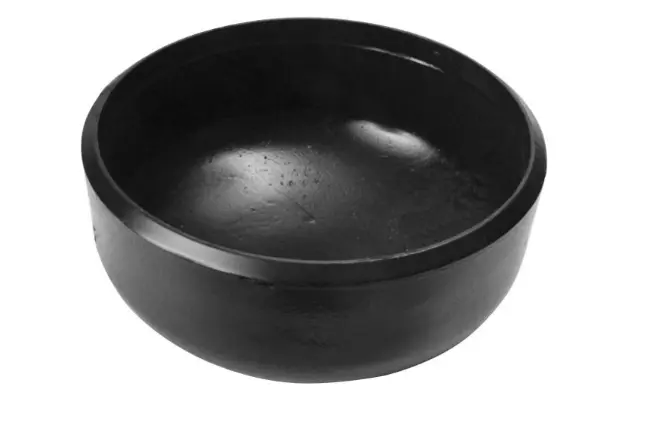
Understanding ASME B16.9 Pipe Caps: Specifications and Design Principles
What Is an ASME B16.9 Pipe Cap?
A pipe cap is a wrought buttwelding fitting used to terminate the open end of a pipe run. Caps are made from NPS ½ to NPS 48 (DN 15 to DN 1200) in accordance with ASME B16.9. The standard contains standards for dimensions, tolerances, end preparation, surface contours, and proof testing. However, the cap is welded directly to the pipe and so has no pressure class of its own, but is rated to withstand the same allowed pressure as the attached straight pipe of equal schedule and material grade.
Critical Design Elements That Resist Leaks
The wall thickness is a direct measure of pressure capacity. The minimum wall thickness at any point should not be less than 87.5% of the nominal schedule wall. This is the same rule applied to elbows and tees under the ASME B16.9 standard. End bevels are cut to 37.5 degrees per ASME B16.25, establishing the weld prep geometry required for full-penetration groove welds. That joint geometry is what takes a mechanical connection and turns it into a metallurgically bonded, leak-proof seal.
Material Options and Their Role
The caps are available in carbon steel (ASTM A234 WPB), stainless steel (ASTM A403 WP304/WP316), and alloy steel grades such as ASTM A234 WP5 and WP9. Corrosion resistance and high-temperature performance are both functions of material selection. WPB carbon steel is economical for ordinary pipework and water conservancy. Stainless grades are suitable for chemical and offshore operations where chloride-induced corrosion is a problem. These alloy grades address high-temperature power-generating and refinery applications over 500 °F.
How ASME B16.9 Pipe Caps Prevent Leaks: Technical and Practical Insights
Seamless vs. Welded Cap Construction
Seamless caps are cast from a solid billet with no longitudinal weld seam; therefore, the weld seam is not a possible leak start point. Welded caps have a seam weld which must fulfill radiological acceptability standards. Seamless construction is usually called for in procurement standards for high-pressure oil and gas service. Welded caps are appropriate for water conservancy or building with lower pressure, and the material cost is minimal.
Welding and Installation Practices That Protect the Joint
Even a properly designed cap will leak if the field weld is bad. The bore of the pipe end and cap must be clean and aligned within the tolerances specified in ASME B16.9 Pipe Cap and devoid of scale or mill coating in the heat-affected zone. If the carbon equivalent is over the specified limits, preheat is required. Depending on wall thickness and service code, post-weld heat treatment (PWHT) may be required. Following these rules turns the engineering design purpose of the cap into a joint that actually retains pressure in service.
Common Leakage Causes the Standard Addresses
The most frequent leaks in caps in industrial pipelines arise from three failure modes: an open root gap due to dimensional mismatch, material flaws in the cap body such as laminations or inclusions, and inadequate weld penetration. All three are immediately countered by ASME B16.9. Root gaps are prevented by tight dimensional tolerances. Mandatory manufacturing tests such as hardness checks and dimensional audits eliminate body flaws. The beveled end prep provides a physical form that allows full-penetration welding so there’s no chance of partial fusion.
Comparative Analysis: ASME B16.9 Pipe Cap vs Alternative Pipe End Closures
ASME B16.9 Cap vs. Threaded and Socket-Weld Caps
Threaded and socket-weld caps (governed by ASME B16.11) introduce mechanical interfaces — threads or socket crevices — that can loosen under vibration or corrode under aggressive fluids. ASME B16.9 butt weld caps eliminate those interfaces entirely. The weld is permanent, crevice-free, and rated to pipe burst strength. For operating pressures above 2,000 PSI or temperatures beyond 400 °F, butt weld caps are the standard choice across oil, gas, and power generation piping codes.
Seamless vs. Welded ASME B16.9 Caps: Balancing Performance and Cost
Seamless caps command a price premium of roughly 15–25% over welded equivalents in equivalent grades and schedules. For critical service (hydrogen, H₂S, or high-cycle fatigue), that premium is justified. For standard water or steam service, welded caps with proper radiographic qualification perform equivalently. Procurement teams should define service severity in the material requisition so suppliers can offer the right construction without over-specifying, keeping project budgets controlled.
Selecting the Right Size and Schedule
Cap selection requires matching the nominal pipe size and schedule (wall thickness) to system design pressure. A Schedule 40 cap carries the same allowable pressure as Schedule 40 pipe of the same grade; upgrading to Schedule 80 or higher raises pressure capacity proportionally. Environmental factors — soil burial, cyclic thermal loading, external impact — can also influence schedule selection. Reviewing ASME B31.3 or B31.1 design code requirements before finalizing the purchase specification avoids costly substitutions in the field.
Procurement Guide for ASME B16.9 Pipe Caps in Global B2B Markets
Verifying Supplier Certification and Quality Systems
When sourcing an ASME B16.9 Pipe Cap supplier for international projects, two documents matter most: ISO 9001 certification and a special equipment manufacturing license issued under Chinese national regulation (for China-origin supply). These confirm that the manufacturer operates a documented quality management system from raw material receipt through finished goods inspection. Oudi holds both, and our full-inspection system — including nondestructive flaw detection at every production stage — means every cap leaving our facility carries traceable quality records.
Oudi has supplied pipe fittings to over 300 customers across more than 40 countries since 1998. Our 66,600 m² production facility in Cangzhou, China's recognized pipe fitting manufacturing hub, runs an annual output of 16,000 tons across carbon steel, stainless steel, and alloy steel fittings. Product lines cover caps, elbows, tees, reducers, and flanges to American (ANSI/ASME), Japanese (JIS), German (DIN), and British (BS) standards.
Key Ordering Considerations for Global Buyers
Here are the practical factors EPC contractors and distributors should confirm before placing an order:
- Certifications on record: Request the ISO 9001 certificate number and verify validity before issuing a purchase order.
- Material test reports (MTRs): Each heat of material should carry certified chemical and mechanical test data traceable to the finished fitting.
- Dimensional inspection reports: Confirm that cap OD, bore, and length-to-end dimensions are checked against B16.9 tables before shipment.
- Lead time and MOQ: Oudi accommodates both project-volume orders and smaller distributor quantities, with lead times confirmed at order placement.
These checks protect your supply chain from substitution risk and ensure the caps you receive perform exactly as the piping design requires.
Supplier Support and Long-Term Partnership Value
Beyond product delivery, reliable suppliers provide technical assistance when procurement specifications need clarification, or when a non-standard size is required. Oudi's engineering team supports customers from specification review through delivery confirmation, and we offer customization across material grades, schedules, and end preparations. For inquiries, contact us directly at oudi-04@oudiguandao.com.
Case Studies and Real-World Applications Demonstrating Leak-Free Performance
Oil and Gas Pipeline Applications
ASME B16.9 caps seal hydrotest ends and permanent dead-leg terminations in midstream pipeline installations at pressures over 2000 PSI. Field engineers use seamless carbon steel WPB caps with PWHT for sour service (H₂S-containing conditions), where hydrogen-induced cracking at weld seams is a known source of failure. Full penetration butt welds, radiographically inspected to ASME B31.8, have a history of no leaks in decades of service in these applications.
Chemical and Refinery Processing
Commonly used for stainless steel WP316 caps in chloride-loaded process streams in chemical industries. The austenitic microstructure resists the pitting corrosion that would penetrate a carbon steel cover in months. Hydrostatic testing of 304/316 stainless caps placed in distillation unit drain lines at one refinery expansion project provided by Oudi passed at 1.5× design pressure with no reported leaks, meeting ASME B31.3 approval standards.
Power Generation and Boiler Systems
Alloy steel caps (ASTM A234 WP9) are used in supercritical steam systems to withstand cyclic thermal stress at temperatures exceeding 1,000 °F. ASME B16.9 requires consistent wall thickness, thereby eliminating stress concentration zones that might nucleate fatigue fractures during repeated heat-up and cool-down cycles. Main steam dead end caps made from B16.9 alloy specified by power plant operators are said to have inspection intervals of years, not months.
Conclusion
For leak-free pipes, all of the components in the system must match their specification. That confidence comes from an ASME B16.9 pipe cap, with defined dimensions, a required minimum wall thickness, standardized bevel prep, and material certification, all supported by production testing. When the cap is put into service correctly, it is metallurgically indistinguishable from the pipe itself when welded to the criteria of the ASME piping code. For procurement experts responsible for choosing fittings for oil, gas, chemical, or power projects, specifying ASME B16.9 and purchasing from a certified manufacturer with documented quality controls is the easiest route to a leak-free system.
FAQ
1. What materials are available for ASME B16.9 pipe caps?
Caps are produced in carbon steel (ASTM A234 WPB), stainless steel (ASTM A403 WP304/WP316), and alloy steel (ASTM A234 WP5, WP9, WP11, WP22). Material selection should match the process fluid, operating temperature, and corrosion environment defined in the piping design specification.
2. Can ASME B16.9 pipe caps be custom-manufactured to non-standard dimensions?
Yes. Manufacturers with advanced forming equipment can produce caps outside standard NPS ranges or in heavier wall schedules to meet specific pressure requirements. Confirm the supplier holds the applicable quality certifications before ordering non-standard items.
3. How do I verify that a cap complies with ASME B16.9?
Request the dimensional inspection report, material test report, and the manufacturer's ISO 9001 certificate. For critical service, additionally request radiographic test reports on welded caps or a certificate of compliance referencing the specific ASME B16.9 edition.
4. Does an ASME B16.9 pipe cap have a pressure class rating?
No. Unlike flanges governed by ASME B16.5, B16.9 fittings carry no pressure class. The cap is designed to match the burst strength of straight pipe of the same nominal size, schedule, and material grade.
5. Is post-weld heat treatment required after installing a B16.9 cap?
PWHT requirements depend on the governing piping code (e.g., ASME B31.3 or B31.1), the base metal carbon equivalent, and the weld wall thickness. The cap itself is heat-treated during manufacture; the field weld connecting it to the pipe may require stress relief per the applicable code and service conditions.
Connect with Oudi for Certified ASME B16.9 Pipe Cap Solutions
Oudi has manufactured and exported pipe fittings since 1998, backed by ISO 9001 certification and a special equipment manufacturing license. Whether you need carbon steel, stainless, or alloy steel pipe caps for your next oil, gas, chemical, or power project, our team is ready to assist. Reach our ASME B16.9 pipe cap supplier team directly at oudi-04@oudiguandao.com and receive product specifications, material certifications, and a competitive quote within one business day.
References
1. American Society of Mechanical Engineers. ASME B16.9: Factory-Made Wrought Buttwelding Fittings. ASME, 2018.
2. American Society of Mechanical Engineers. ASME B31.3: Process Piping. ASME, 2022.
3. STM International. ASTM A234/A234M: Standard Specification for Piping Fittings of Wrought Carbon Steel and Alloy Steel for Moderate and High Temperature Service. ASTM, 2022.
4. ASTM International. ASTM A403/A403M: Standard Specification for Wrought Austenitic Stainless Steel Piping Fittings. ASTM, 2021.
5. American Society of Mechanical Engineers. ASME B16.25: Buttwelding Ends. ASME, 2017.
6. Nayyar, Mohinder L. Piping Handbook, 7th ed. McGraw-Hill, 2000.

Need help finding the right solution with our experts. Please contact us.

SINCE 1998 Your Reliable Pipeline Manufacturer



