Where to Use Equal Tee vs Reducing Tee in Piping Layouts?
Selecting the right branch fitting can have a direct effect on how a piping system is arranged, maintained, and operated. Equal tees and reducing tees may look similar because both create a three-way connection, but they are intended for different piping configurations. The only thing is the size of the branch connection. A decreasing tee has a smaller branch connection and a bigger main run connection, whereas an equal tee has the same nominal size at the branch and run connections. That difference becomes significant if a pipe plan has branches servicing equipment, process lines, instruments, or secondary distribution systems with varying flow needs. So the decision between the two is not just a question of choice. The engineer will have to evaluate needed pipe size, projected flow rate, pressure loss, available installation space, material specification, operating circumstances, and appropriate piping standards. A fitting that seems to be acceptable only from the nominal diameter may not be adequate when you analyze the whole pipe layout. For this reason, equal tees are often used if the run and branch need the same pipe size, while decreasing tees are used where the branch line is to be purposefully smaller than the main pipe. Understanding where each layout is appropriate helps remove unneeded reducers, simplify fabrication, and ease inspection and maintenance of the final pipe system.
How Equal Tees and Reducing Tees Differ in a Piping Layout?
Equal Tee Geometry and Typical Connection Arrangement
An equal tee has three apertures of equal nominal pipe size. The run goes through the fitting; the branch connects at 90°. All three connections have the same nominal diameter; therefore, it’s especially easy to specify such a fitting when the main line and the branch line are of equal pipe diameters.
This technique is helpful when a branch is carrying a flow rate similar to the main-line section it is attached to or when the pipe design deliberately maintains the same nominal diameter across the branch. For example, a process line has to be divided into two lines of equal size, or a utility header feeds many branches with the same pipe specification.
The key issue is that an equal tee does not always indicate flow will be split evenly across the lines that are joined. Actual flow distribution relies on downstream resistance, valve locations, equipment demand, pipe length, elevation, and other elements in the system. The fit only offers the geometrical link. Engineers still need to check the whole hydraulic system.
Why Reducing Tees Are Used for Smaller Branches?
A reducing tee has a branch connection of a lower nominal diameter than the main line. This enables the branch line to take off from the larger header or process line straight without the need for a separate reducer at the tee connection.
This is especially useful when the main pipe carries a bigger total flow and a single branch feeds equipment or a secondary line that has a lower design flow need. For example, a bigger header may distribute a process fluid to multiple smaller lines. The entire header diameter at each branch would not be necessarily economical or technically warranted in such an arrangement.
A decreasing tee permits the size of the branch to be chosen to meet the needs of the downstream plumbing. But the lesser branch will not be chosen only for the reduction of material consumption. It still must be sized for the desired flow rate, permissible pressure drop, velocity limitations, connection size to the equipment, and relevant design requirements.
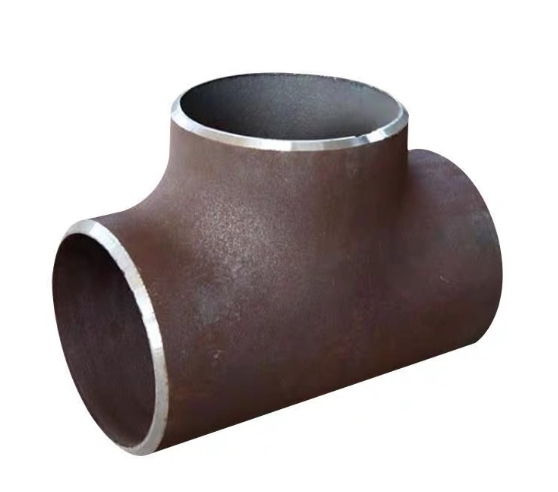
Where an Equal Tee Makes More Sense?
Same-Size Branches in Distribution Headers
Equal tees only make sense when the branch and run are of the same nominal pipe size. This may arise in distribution headers if there are a number of downstream lines of similar sizes. Say you have a DN100 main line that has to connect to another DN100 branch. An equal tee may provide you the 3-way connection you need without a diameter modification.
The same is true of utility systems, cooling-water systems, compressed-air systems, and other pipe systems when the branches are purposefully made the same nominal size as the main run, as is the case with reducing tees in certain piping configurations. The final decision should still be based on the project pipe specification and design circumstances, not only on nominal size.
In these cases an equal tee may also make the piping specification simpler to standardize. If many branches utilize the same size and material grade for the pipe, then a uniform fitting shape may make it easier to purchase, examine, and replace during maintenance.
Layouts Where Consistent Pipe Diameter Is Required
Some pipe systems are intended to maintain a constant nominal diameter to suit hydraulic, process, or equipment requirements. In these instances an equal tee is perhaps more suitable since there is no reduction introduced at the branch connection.
It is not usually the case that an equal tee has less pressure loss than a lowering tee. Local losses depend on the actual shape and flow arrangement; therefore, the fitting should be considered as part of the overall hydraulic model. The shape of the connection that is suitable for the branch size and operating circumstances is important.
Equal tees are also handy if future adjustments are to be made using the same pipe size. In the case when the initial system has adequate capacity, uniformity of the branch specification might facilitate future additions.
Situations Where Reducing Tees Is the Better Choice
Smaller Equipment Connections on Larger Process Lines
A frequent use of reducing tees is to connect a smaller piece of equipment or branch line to a larger process line. The main pipe may need to handle a relatively large total flow; the attached equipment needs a smaller inlet or exit connection.
In this case a reducing tee may make the branch connection immediately. The reducing tee puts the size change within the fitting itself, instead of having a full equal tee and a separate reduction. This may lead to a more compact local pipe configuration and a reduction in the number of individual components to be welded or coupled.
But the selection should be based on the authorized pipe design. In other cases, having a separate reducer is more flexible, especially if the reduction has to happen in a certain area or if future revisions are envisaged.
Multi-Size Piping Networks
In pipe networks that carry various branch diameters, reducing tees are also important. You may have a huge header feeding a blend of medium-sized and small-sized branches. Each branch would be scaled based on the process need.
For example, a process header may have a greater nominal diameter with separate branches connecting pumps, heat exchangers, storage systems, or auxiliary equipment with smaller pipe connections. A decreasing tee will accommodate the variation in size at the branch point, enabling the designer to keep the scheme reasonably compact.
The essential engineering aspect is that the branch diameter should be in accordance with the actual service requirement, especially when selecting reducing tees. Reducing the diameter too much increases velocity and local pressure loss. Thus, tees simplify the physical connection but do not eliminate the necessity for hydraulic analysis.
Piping Layouts With Limited Installation Space
Space may also affect the decision between an equal tee and a lowering tee. When a branch must be reduced from a bigger main line to a smaller pipe, a reducing tee may remove the requirement for an extra reducer and its straight pipe portion.
This may be beneficial in crowded pipe racks, equipment skids, tight utility rooms, and other places where every extra fitting eats into the available installation envelope. A simplified local layout may help minimize the number of welds and connecting points to be examined.
Don’t compromise accessibility even with a small layout. A good fit that saves a little space but complicates inspection, welding, valve operation, or future maintenance may generate a bigger issue throughout the working life of the system.
How Tee Selection Affects Flow and Pressure Loss?
Pressure Loss Depends on the Complete Flow Arrangement
The choice between equal and reducing tees should include consideration of local pressure loss, but the fitting should not be treated as a pressure-control device. A reducing tee changes the flow geometry because the branch has a smaller cross-sectional area than the main run. Depending on the flow direction and branch flow rate, this change can influence local velocity, turbulence, and pressure loss.
The actual effect depends on the ratio between the branch diameter and run diameter, the flow rate, fluid density and viscosity, and the direction in which the fluid enters and leaves the fitting. A tee where most of the flow continues through the run behaves differently from a tee where a significant portion of the flow enters or leaves through the branch.
For engineering calculations, the pressure loss associated with the tee should therefore be evaluated using the appropriate hydraulic method, fitting-loss coefficient, or project design standard. It should not be assumed that every reducing tee produces a predictable or automatically beneficial pressure reduction.
Branch Diameter Should Follow the Required Flow Rate
A smaller branch is not necessarily a better branch. Reducing the pipe diameter can increase fluid velocity, and the resulting pressure loss may become significant if the reduction is excessive or the branch carries a substantial flow rate.
The correct approach is to start with the required process flow and determine an appropriate branch size based on the system design criteria. Once the branch diameter has been established, the engineer can determine whether a reducing tee provides the desired connection or whether an equal tee combined with a separate reducer would be more suitable.
This distinction is particularly important in systems where pumps, compressors, control valves, heat exchangers, or other sensitive equipment are located downstream. The fitting selection needs to support the required pressure conditions at the equipment connection rather than simply minimize the number of components.
What Engineers Should Consider Before Selecting the Tee?
Material, Temperature, and Pressure Requirements
Material selection is one of the basic requirements when specifying any butt-welding tee. The fitting material must be compatible with the pipe material and suitable for the design pressure and temperature of the service.
For carbon steel piping, for example, the engineer may need to specify the applicable material grade and fitting standard rather than simply ordering a “carbon steel tee.” The same principle applies to stainless steel, alloy steel, and other materials used in process or industrial piping.
Operating temperature should also be considered because allowable pressure ratings can vary with temperature depending on the material and applicable design code. The tee, pipe, weld, and other connected components must work together as part of the same piping system.
Size, Schedule, and End Connection
Nominal size alone is not enough information for purchasing a tee. When ordering reducing tees, the procurement specification may also need to define the pipe schedule or wall thickness, material grade, manufacturing standard, end preparation, and inspection requirements.
For a reducing tee, both the run size and branch size need to be stated clearly. An order that specifies only one nominal diameter can create ambiguity and increase the risk of receiving the wrong configuration.
Where butt-welding fittings are involved, the end dimensions and wall thickness should also be compatible with the connected pipe. For projects working to standards such as ASME B16.9, the purchaser should verify that the selected fitting meets the required dimensional and manufacturing requirements.
Fabrication and Maintenance Considerations
The physical configuration of the piping system should be reviewed before finalizing the fitting. A reducing tee may reduce the number of components in a branch connection, but the resulting weld location, orientation, and access still need to work with the fabrication plan.
Maintenance requirements are equally important. Valves, instruments, drains, vents, and equipment connections should remain accessible after the piping is installed. A fitting arrangement that is technically correct on a drawing may still create difficulties if it leaves insufficient space for inspection or replacement.
This is why tee selection should be considered together with the surrounding piping layout rather than as an isolated component decision.
Choosing Between Equal Tees and Reducing Tees for Procurement
Match the Fitting to the Approved Piping Specification
The safest starting point for procurement is the approved piping specification and isometric drawing. These documents should establish the required fitting type, nominal sizes, material grade, wall thickness or schedule, applicable standard, and connection details.
If the drawing specifies an equal tee, replacing it with a reducing tee simply because the latter appears more convenient can affect the intended pipe configuration. Likewise, selecting an equal tee and adding a reducer may change the installation length, weld count, and available space.
Procurement teams should therefore confirm the fitting designation, material grade, nominal size, schedule or wall thickness, end connection, and required inspection or documentation before placing an order.
Consider Total Installation Rather Than Fitting Price Alone
The purchase price of a single fitting is only one part of the cost. A reducing tee may cost more than an equal tee because of its geometry and manufacturing requirements, but it may eliminate a separate reducer and additional welding in a particular layout.
On the other hand, a separate reducer may be preferable when the designer needs a specific transition location, easier future modification, or greater flexibility during fabrication. The most economical solution is therefore not always the fitting with the lowest unit price.
A practical comparison should consider the complete branch connection, including the fitting, reducer if required, welding, inspection, installation space, and maintenance access. This approach gives the project team a more realistic basis for choosing between the two configurations.
Conclusion
The choice between equal tees and reducing tees should be based on the actual requirements of the piping layout rather than on the assumption that one fitting is universally better than the other. Equal tees are appropriate when the run and branch use the same nominal pipe size, particularly in layouts where consistent branch dimensions are required. Reducing tees are more suitable when a smaller branch needs to connect directly to a larger main line, such as in multi-size distribution systems or compact equipment connections.
The most important consideration is the relationship between the branch size and the required flow. A reducing tee can simplify the physical layout and eliminate the need for a separate reducer in some applications, but it does not function as a dedicated pressure-control device. Pressure loss, velocity, and hydraulic performance still need to be evaluated according to the actual flow conditions and piping design.
For procurement, engineers and purchasing teams should also confirm the fitting standard, material grade, run and branch dimensions, schedule or wall thickness, operating temperature and pressure, end preparation, inspection requirements, and documentation. When these factors are considered together, the decision between an equal tee and a reducing tee becomes much more straightforward and can support a piping system that is practical to fabricate, inspect, operate, and maintain. For expert guidance on selecting the right fittings for your piping system, contact Cangzhou Oudi Pipe Manufacture Co., Ltd. at oudi-04@oudiguandao.com.
FAQ
1. What is the main difference between an equal tee and a reducing tee?
An equal tee has the same diameter for all three openings, while a reducing tee has a smaller branch outlet compared to the main run.
2. When should I use a reducing tee instead of an equal tee?
Use a reducing tee when you need to connect a smaller branch line to a larger main line, or when you want to control flow distribution and pressure in branch lines.
3. Do reducing tees cause more pressure drop than equal tees?
Generally, yes. Reducing tees can cause more localized pressure drop due to the sudden contraction at the branch outlet, but this can sometimes be beneficial for pressure control.
4. Are reducing tees more expensive than equal tees?
Reducing tees often have a higher upfront cost due to their more complex design, but they can lead to overall cost savings by simplifying piping layouts and improving system efficiency.
References
1. Smith, J. D. (2018). Piping System Design: Principles and Applications. Mechanical Engineering Press.
2. Johnson, R. W. (2019). Fluid Dynamics in Pipe Fittings. Journal of Fluid Mechanics, 45(3), 278-295.
3. Thompson, L. K. (2020). Comparative Analysis of Equal and Reducing Tees in Industrial Piping. Industrial Engineering Quarterly, 32(2), 112-128.
4. Brown, A. C., & Davis, E. F. (2017). Pressure Loss Characteristics of Pipe Fittings. ASME Journal of Fluids Engineering, 139(6), 061201.
5. Wilson, M. R. (2021). Material Selection for Corrosive Environments in Piping Systems. Corrosion Science and Technology, 56(4), 389-405.
6. Lee, S. H., & Kim, Y. J. (2019). Energy Efficiency in Industrial Piping: A Comprehensive Review. Energy and Buildings, 201, 352-368.

Need help finding the right solution with our experts. Please contact us.

SINCE 1998 Your Reliable Pipeline Manufacturer



