High Temperature Pipe Tee vs Standard Tee: Key Differences
When specifying pipe fittings for industrial applications, the choice between a High Temperature Pipe Tee and a standard tee directly impacts system safety, operational longevity, and total cost of ownership. High temperature pipe tees are metallurgically engineered to resist creep deformation, oxidation scaling, and thermal fatigue at temperatures exceeding 400°C, utilizing chrome-molybdenum alloys or nickel-based materials that maintain structural integrity under extreme thermal stress. Standard tees, typically fabricated from carbon steel or 304 stainless steel, perform reliably in moderate-temperature environments but lack the specialized heat treatment and alloy composition necessary for sustained high-temperature service. Understanding these distinctions enables procurement teams to match component specifications with actual operating conditions, preventing premature failure and costly unplanned downtime.
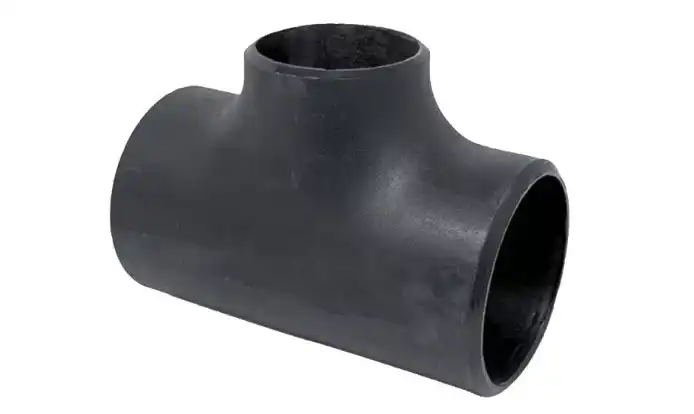
Key Differences Between High Temperature Pipe Tees and Standard Pipe Tees
Material Composition and Metallurgical Properties
The main difference is in the chemistry of the alloy and the way it is heated. High Temperature Pipe Tees are made from materials that have been engineered at the molecular level to be stable at high temperatures. Chrome-Molybdenum types like WP91 have carefully measured amounts of chromium, molybdenum, and vanadium that work together to make stable carbide structures. These structures keep the grain boundaries from weakening when exposed to high temperatures for a long time. In industrial settings where hydrocarbons and sulfur compounds attack regular steels, nickel-based alloys like Inconel 625 are much more resistant to being carburized and sulfidated than any other alloy. Standard tees are made of carbon steel with basic alloying, which is best for mechanical strength at room temperature to mild temperatures but can change microstructurally above 450°C. The amount of carbon in WPB carbon steel is fine for most uses, but when it is exposed to high temperatures for a long time, carbides can form at the grain boundaries, which weakens the steel. Even though stainless steel 316L is better at resisting corrosion than carbon steel, it still loses a lot of strength and starts to scale when heated above 600°C. At Oudi, we make sure that all of our materials come from certified mills and that they meet our strict quality standards. For every production batch, we use XRF analyzers to do Positive Material Identification testing to make sure that the alloy composition meets our standards. This is an important quality control step that keeps expensive field failures from happening because of bad materials.
Manufacturing Methods and Structural Integrity
The way something is made has a direct effect on how well it works under thermal stress. High Temperature Pipe Tees go through hot forging processes that smooth out the grain structure and get rid of any internal holes. This makes a thick, even microstructure that can handle both mechanical stress and heat shock. Post-Weld Heat Treatment (PWHT) is required for Chrome-Moly grades. It relieves leftover stresses that were created during forming and stops stress corrosion cracks while the grade is in use. Our high-tech production tools include controlled-atmosphere heat treatment furnaces that exactly control the rates of heating and cooling based on time-temperature curves for each material, guaranteeing the best mechanical qualities. Standard tees are usually made by welding larger pieces together or forming smaller pieces together without any seams. These methods work well for moderate service conditions but don't have the added strength of forged high-temperature fittings. Wall thickness tolerances are very different. For high-temperature applications, tighter dimensional control is needed to avoid stress buildup in one place at the branch crotch area, where thermal expansion causes the most strain. As part of our quality assurance program, we use ultrasonic thickness mapping and radiographic testing on high-temperature tees to find any flaws below the surface that could spread when the temperature changes over time.
Temperature and Pressure Performance Ratings
Operating limits clearly separate these fitting groups. High Temperature Pipe Tees keep the structure strong and keep the pressure inside at temperatures where regular fittings would quickly lose their strength. Up to 600°C, ASTM A234 WP91 keeps its useful mechanical properties. This makes it perfect for supercritical steam systems used in power generation where pressures are higher than 250 bar. It can be used in hydrogen reforming and ethylene cracking furnaces up to 1100°C thanks to specialized types like Alloy 800H. Standard carbon steel bolts lose a lot of their yield strength above 350°C. They also creep faster, which limits how long they can safely be used in high-temperature situations. The pressure-temperature rating curves in ASME B31.3 make this performance gap very clear: a Schedule 40 carbon steel tee that can hold 2000 psi at 20°C drops to about 800 psi at 400°C, but a WP91 chrome-moly equivalent can hold over 1500 psi at the same temperature. To make sure there are enough safety margins, procurement teams must compare these ratings to the actual process conditions, such as transient upset scenarios and thermal cycling during startup and shutdown.
Applications and Performance Considerations
High Temperature Industrial Environments
Power plants are the most difficult places for High Temperature Pipe Tees to be used. In supercritical and ultrasupercritical thermal plants, steam that is 600°C hot and under 300 bar of pressure is sent from boilers to turbines. Normal materials would break in weeks in this situation. The High Temperature Pipe Tee guides this flow through complicated networks of pipes and stops oxidation scaling, which weakens walls and creates leak paths. Power plants in Southeast Asia and the Middle East buy WP91 and WP92 chrome-moly tees from Oudi. Our advanced inspection protocols, which include creep testing and metallographic examination, make sure that the tees will last for a long time. In petrochemical plants, high-temperature fittings are used in ethylene cracking furnaces that work at 850°C, hydrocracking units that deal with volatile fuels at very high temperatures, and catalytic reforming processes that break down normal steels through carburization. The High Temperature Pipe Tee has to be able to handle not only heat but also chemical attacks from sulfur compounds, hydrogen, and high-velocity process streams that wear it down. Our alloy steel tees with nickel and chromium in them form protective oxide layers that fix minor surface damage on their own, which means they can go longer without being inspected.
Standard Tee Applications and Economic Considerations
Standard tees always work well in industrial processes that use moderate temperatures and cost a lot less to make. Carbon steel or 304 stainless steel tees are the most cost-effective choice for water conservation projects, building HVAC systems, shipboard piping networks, and general industrial construction projects that don't have to deal with temperatures above 150°C. Compared to parts made of rare alloys, these are easier to weld, more common, and require less work to install. For applications that operate under more demanding thermal conditions, a High Temperature Pipe Tee can provide the specialized performance needed to handle elevated temperatures reliably. Maintenance plans for different types of fittings are very different. When installed outside, standard carbon steel tees need to be inspected regularly for corrosion and protective coating upkeep. Stainless steel options make this task easier. For high-temperature fits, specific non-destructive testing methods are needed. For example, radiographic inspection can find internal cracks caused by thermal fatigue, and hardness testing can make sure that heat treatment hasn't weakened the metal's tensile qualities during service. When you figure out the total cost of ownership, you have to include the costs of these inspections, keeping spare parts on hand, and the chance of losing production due to unplanned shutdowns. Our technical team helps procurement managers make lifetime cost models that show how the higher costs of materials at first compare to the money saved on upkeep and better reliability over time.
Procurement Guide for High Temperature Pipe Tees
Critical Certification and Compliance Requirements
When looking for high-temperature pipe fittings, manufacturers' credentials and product certifications must be carefully checked. Certification as an ISO 9001 quality management system gives basic assurance of process controls, but for high-stakes uses, more validation is needed. Look for companies that have special licenses from national regulatory bodies to make equipment, API monogram licenses for use in the oil business, and ASME code stamp permission for parts that go into pressure vessels. Oudi keeps all of these certifications up to date with regular audits by outside parties that make sure our quality systems meet international standards. Material test reports must accompany every production lot that lists the chemicals used, the mechanical properties, and the heat treatment parameters. Ask for Mill Test Certificates that can be linked to the original certifications from the steel mill, not just any old paperwork. For important uses, ask for witness testing, in which your quality testers watch as we do non-destructive testing and mechanical testing at our site before the goods are shipped. Digital radiography systems, phased-array ultrasonic flaw detectors, and automated dimensional measurement systems are some of the inspection tools we use. They give us objective proof that the product meets your needs.
Supplier Evaluation and Partnership Development
The reputation and production ability of the manufacturer have a direct effect on the success of the project. Check out possible sources based on how much they can produce. Our annual output of 16,000 tons guarantees consistent supply without the wait-time uncertainty that smaller fabricators face. The fact that Oudi has users in Europe, the Americas, Africa, and Asia shows that they have experience exporting and can handle the business of foreign shipping. They do this by working with established freight forwarding partners that cut down on transit times and customs problems. Technical skill is what sets good makers apart from great partners. Our engineering team helps you choose the right materials based on your process conditions. They also do finite element analyzes of how thermal stress is distributed in complicated pipe configurations and check for compatibility when connecting high-temperature fittings to existing systems. We keep a large stock of raw materials in carbon steel, stainless steel, and alloy steel types. This lets us respond quickly to urgent project needs or changes to the plan while the building is being built.
Cost Optimization Strategies for Bulk Procurement
The price of a High Temperature Pipe Tee is based on the material used. Chrome-moly and nickel alloys are much more expensive than carbon steel. Talk to manufacturers about making volume commitments that will help them buy raw materials and plan their production schedules more efficiently. This could lower the cost per unit by 15 to 20 percent compared to buying on the spot. Oudi has framework agreements for EPC contractors and big end-users that lock in prices for 12 months while still allowing for flexible delivery schedules that are in line with building milestones. Consider total landed cost rather than focusing solely on FOB pricing. Because we are close to Tianjin Port, we can quickly load containers and offer competitive ocean freight rates to North American destinations. Also, our knowledge of export documentation cuts down on delays in customs clearance. If you ask for a value engineering review, our technical team will suggest different materials or changes to the design that will keep the performance while lowering costs. For example, a forged WP22 tee may offer enough service life at a much lower cost than WP91 for lower-temperature applications.
Conclusion
If you want to choose between High Temperature Pipe Tees and other options, you need to carefully look at the operating conditions, performance needs, and lifecycle costs. High Temperature Pipe Tees made from chrome-molybdenum alloys, high-grade stainless steels, or nickel-based materials are very reliable in places with very high temperatures, where regular fittings would break quickly. Standard tees made of carbon steel and stainless steel are cost-effective options for moderate-temperature uses in a wide range of industries. Partnering with ISO-certified manufacturers who show technical know-how, maintain strict quality control, and provide full engineering support is key to successful procurement. Oudi has been making pipe fittings for 25 years, and we have customers all over the world. This shows that we are dedicated to meeting the strict requirements of the oil, chemical, power production, and water conservation businesses.
FAQ
What material grade is optimal for steam service at 550°C?
The ASTM A234 WP91 chrome-molybdenum alloy is the usual choice for uses involving superheated steam at 550°C. It has great resistance to oxidation and creep-rupture strength. This material keeps its shape even when it's under constant heat stress, and it doesn't scale, which makes pipe walls thinner. Post-Weld Heat Treatment is needed to get certain mechanical properties and keep the weld from breaking too soon.
Why choose seamless high temperature pipe tees over welded construction?
Seamless high temperature tees get rid of the weak spot that can happen at longitudinal weld seams. This makes the material stronger in all directions and better at resisting thermal cycle wear. Forged seamless construction gives these fittings a fine grain structure that makes them more resistant to creep. This makes them perfect for high-pressure headers and important branch connections where failure would have serious consequences. Because seamless manufacturing is so accurate in terms of size, it also cuts down on installation time and welding rework.
What are typical lead times for custom high-temperature tee orders?
Standard setups in common sizes usually ship within 4 to 6 weeks of receiving an order. Custom sizes or unusual alloy materials may take 8 to 12 weeks, based on the supply of raw materials and the plan for heat treatment. At Oudi, we keep a strategic inventory of grades and sizes that are often asked for so that we can speed up delivery for urgent project needs. We can also speed up production for items that are on a critical path.
Partner with a Trusted High Temperature Pipe Tee Manufacturer
Oudi has been making specialized products for 25 years and can handle your toughest pipe fitting jobs. Our factory is ISO 9001-certified and makes High Temperature Pipe Tees from chrome-molybdenum, stainless steel, and alloy steel. These are made to meet foreign standards from ASME, ASTM, JIS, DIN, and BS. With the ability to produce 16,000 tons per year and full quality control from checking the raw materials to the final inspection, we can give your important building projects the dependability they need. Our research team is ready to help you choose the right materials, write specifications, and solve technical problems in a way that maximizes both performance and cost-effectiveness. You can email our High Temperature Pipe Tee supplier team at oudi-04@oudiguandao.com or visit https://blog.odpipefitting.com/ to talk about your unique needs and get a full quote backed by our dedication to making the best products possible.
References
1. American Society of Mechanical Engineers. (2020). ASME B16.9: Factory-Made Wrought Butt-Welding Fittings. New York: ASME Press.
2. Davis, J.R. (2006). Metals Handbook: Properties and Selection of Irons, Steels, and High-Performance Alloys. Materials Park: ASM International.
3. Becht, C. (2018). High-Temperature Piping Design and Creep Analysis. Houston: Engineering Design Press.
4. American Petroleum Institute. (2016). API 570: Piping Inspection Code: In-Service Inspection, Rating, Repair, and Alteration of Piping Systems. Washington: API Publishing.
5. Viswanathan, R. (1995). Damage Mechanisms and Life Assessment of High-Temperature Components. Materials Park: ASM International.
6. British Standards Institution. (2019). BS EN 10216-2: Seamless Steel Tubes for Pressure Purposes—Technical Delivery Conditions for Non-Alloy and Alloy Steel Tubes with Specified Elevated Temperature Properties. London: BSI Standards.

Need help finding the right solution with our experts. Please contact us.

SINCE 1998 Your Reliable Pipeline Manufacturer



