How to buy a Cost-effective carbon steel elbow?
In order to purchase a cost-effective carbon steel elbow, it's important to strike a balance between proven quality, accurate specs, and dependable supply, not simply the lowest unit price. The right elbow should conform to the pressure rating, bend angle, and connection technique of your system and should comply with standards such as ASME B16.9 or ASTM A234. Procurement managers in oil, gas, chemical and water conservancy projects have always found that the greatest value, across the complete service life of the component, is achieved when sourced from an ISO 9001 certified manufacturer with established export experience.
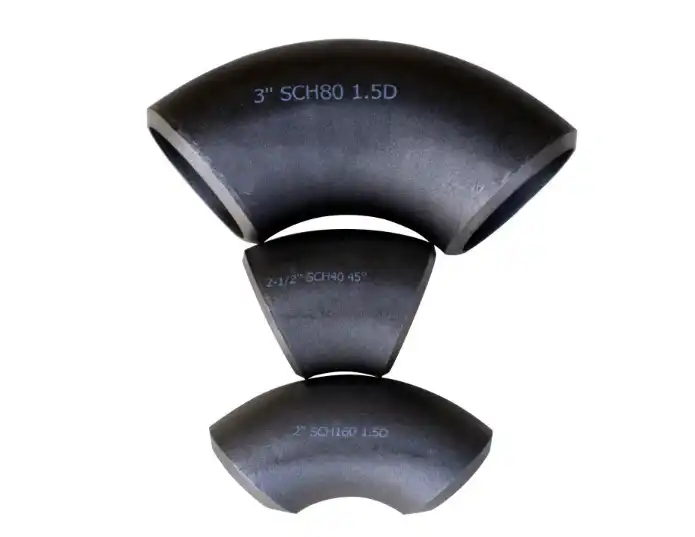
What Exactly Is a Carbon Steel Elbow — and Why Does It Matter?
Carbon steel elbow is a pipe fitting that alters the direction of flow of fluid or gas in a pipeline system. The bending angle is usually 45°, 90° or 180° depending on which the directional shift is determined. Industrial plumbing networks depend on dependable elbows to operate safely under pressure.
What Types Are Available?
There are mainly two production types of carbon steel elbows, they are seamless and welded (ERW). Joining methods include butt welding, socket welding or threaded ends. The radius possibilities are short radius (SR, 1x D) and long radius (LR, 1.5x D). Short radius elbows are suited for compact installation locations – prized in oil refining and water treatment facilities — while long radius elbows minimize pressure drop over high-flow systems. If you’re working on a project where you need to balance performance and price, a cost-effective carbon steel elbow is a great choice that doesn’t compromise durability.
Why Carbon Steel Over Other Materials?
Carbon steel elbows, manufactured to ASTM A234 WPB or ASTM A105 specifications, provide superior tensile strength at a far cheaper price per unit than stainless steel or alloy steel equivalents. Preferred option worldwide in the petroleum, chemical, natural gas and construction industry. Rated for a broad pressure & temperature range as per ASME B16.9 requirements.
How Do You Choose the Right Carbon Steel Elbow for Your Project?
Selecting the wrong elbow specification leads to system failures, costly replacements, and unplanned downtime. Matching the fitting to your actual operating parameters is non-negotiable.
Here is a practical comparison to guide your material and specification decision:
| Criteria | Carbon Steel Elbow | Stainless Steel Elbow | Alloy Steel Elbow |
|---|---|---|---|
| Cost | Low to moderate | High | High |
| Pressure Resistance | High | High | Very High |
| Temperature Range | Up to ~425°C | Up to ~870°C | Up to ~650°C |
| Corrosion Resistance | Moderate | Excellent | Good |
| Best Application | General industrial, oil & gas | Food, pharmaceutical, marine | High-temp, high-pressure plants |
Carbon steel is the dominant choice for standard industrial pipelines where fluid media is not highly corrosive and budgets require accountability.
Seamless vs. Welded: Which Performs Better?
Seamless elbows are manufactured without a weld seam, producing uniform grain structure and superior mechanical integrity — critical for high-pressure, high-temperature services such as boiler feed lines and natural gas transmission. Welded elbows, produced by forming and welding plate or pipe, offer competitive pricing for lower-pressure applications like construction water systems or shipbuilding. For most oil and gas procurement scenarios, seamless is the technically sound, long-term economical choice despite a higher upfront cost.
What Bend Angle and Dimension Do You Need?
Standard specifications cover 45° and 90° elbows in both SR and LR configurations, available from ½" through 48" nominal pipe sizes. Where standard dimensions fall short — unusual pipe schedules, non-standard bore sizes, or project-specific geometry — reputable manufacturers like Oudi offer custom sizing to ANSI, DIN, JIS, and BS standards, providing a cost-effective carbon steel elbow option for both standard and specialized applications.
How Do You Evaluate Suppliers Without Overpaying or Under-Specifying?
Procurement specialists either defend or undermine their project margins during the supplier selection stage. For a supplier there are three pillars worth auditing: certificates, manufacturing capacity and export track record.
These are the basic assessment factors any B2B buyer has to check:
- ISO 9001 Certification and Special Equipment Manufacturing License: These are the basic qualifications and non-negotiable. They ensure the supplier has a documented quality control system from raw material input to finished-goods inspection. Oudi is ISO 9001:2000 Certificated, and the People’s Republic of China Special Equipment Manufacturing License. The whole manufacturing line of Oudi is equipped with comprehensive non-destructive fault detection.
- Annual Production Capacity and Supply Chain Consistency: With an annual production capacity of 16,000 tons, a supplier can deliver bulk orders on time. Oudi’s Cangzhou plant has 66,600 square meters with state-of-the-art manufacturing equipment and a strong technical staff backing it up – a proven competency that smaller trade enterprises can’t compete with.
- Global Export Experience: Proven Track Record Since 1998, Oudi has successfully serviced 300+ clients in 40+ countries spanning Europe, North and South America, Africa, Southeast Asia and the Middle East. That track record makes procurement risk for foreign customers quite low.
These criteria are immediately translated into procurement results. Protecting your project deadline & quality compliance concurrently with a certified experienced manufacturer.It’s virtually always cheaper per unit to buy in bulk. Be sure to discuss MOQ minimums, lead times for normal vs bespoke orders and packing and delivery arrangements before signing any purchase contract.
How Do You Balance Price, Quality, and Delivery in the Final Decision?
In industrial buying, it’s not the line item on the purchase order that counts, it’s the total cost of ownership. A cheaper elbow that fails at rated pressure means replacement costs, downtime penalties and possible safety liabilities that much outweigh the initial save.
When comparing quotes, consider wall thickness compliance with schedule (Sch 40, Sch 80, Sch 160), material certification (Mill Test Reports, MTRs), and heat treat records. Oudi’s quality control method, which involves detailed checks at each phase of manufacturing and state-of-the-art detection technology to satisfy different customer testing needs, continually ensures on-spec delivery of the cost-effective carbon steel elbow to international industrial customers.
The dependability of the delivery is equally important. Oudi’s closeness to Tianjin Port and quick access via the main transport links provide for seamless global logistics – a practical benefit for EPC contractors and distributors battling project timelines.
What Should You Do After Receiving Your Carbon Steel Elbows?
Protecting your procurement investment extends well beyond the delivery date. Proper handling and storage preserve the mechanical properties and surface condition of elbows before installation.
Store elbows in a dry, covered environment away from direct moisture exposure. Apply protective end caps to prevent contamination of beveled weld ends. During installation, verify alignment carefully before welding to avoid residual stress concentrations that accelerate fatigue at operating pressure. After commissioning, schedule routine visual inspections and corrosion monitoring — particularly in chemical or saline environments — to catch early degradation before it progresses to failure.
Conclusion
“Unit price is not the only criteria for reliable carbon steel elbows procurement, specifications, supplier credentials and total cost are also factors to consider. From 45° short radius fittings in confined refinery areas to big bore 90° seamless elbows in natural gas transmission lines, the correct component from a licensed, experienced manufacturer helps maintain project budgets and operational safety. If you want to restrict the budget in a project but cannot compromise on quality, then a cost-effective carbon steel elbow of Oudi is the best choice. Oudi has been delivering to this standard since 1998, supplying industrial customers in 40+ countries with a full variety of pipe fittings constructed to ANSI, DIN, JIS and BS specifications.
FAQ
What Is the Difference Between Schedule 40 and Schedule 80 Carbon Steel Elbows?
Schedule 40 elbows have a thinner wall and suit moderate-pressure applications such as water distribution and low-pressure process lines. Schedule 80 elbows carry a heavier wall thickness and handle elevated pressure and temperature conditions, typical in oil, gas, and chemical service. Your operating pressure and fluid temperature ratings determine which schedule is appropriate for your system.
Are Custom-Sized Carbon Steel Elbows Available?
Yes. Manufacturers like Oudi produce elbows to custom specifications covering non-standard pipe sizes, wall thicknesses, and bore configurations. Custom orders should be accompanied by detailed drawings or dimensional sheets referencing the applicable standard (ANSI, DIN, JIS, or BS) to ensure accurate fabrication.
What Are Typical Lead Times for Bulk Orders From a Certified Supplier?
Standard-specification elbows in common sizes typically carry lead times of two to four weeks depending on order volume and material grade. Custom-sized or specialty-grade orders may require four to eight weeks. Confirming lead times and production schedules at the quotation stage prevents downstream project delays.
Request a Quote From Oudi — Your Trusted Carbon Steel Elbow Supplier
Oudi has manufactured and exported pipe fittings since 1998, with 16,000 tons of annual capacity and ISO 9001 certification backing every order. Whether you need standard or custom cost-effective carbon steel elbows, our team delivers tailored quotes, competitive bulk pricing, and reliable global logistics. Contact us directly at oudi-04@oudiguandao.com to discuss your specifications and receive a prompt response.
References
1. ASME B16.9 — Factory-Made Wrought Buttwelding Fittings, American Society of Mechanical Engineers, 2018.
2. ASTM A234/A234M — Standard Specification for Piping Fittings of Wrought Carbon Steel and Alloy Steel for Moderate and High Temperature Service, ASTM International, 2021.
3. ASTM A105/A105M — Standard Specification for Carbon Steel Forgings for Piping Applications, ASTM International, 2022.
4. Nayyar, M.L. — Piping Handbook, 7th Edition, McGraw-Hill, 2000.
5. Smith, P. & Vivian, B.E. — Piping Materials Guide: Selection and Applications, Elsevier, 2005.
6. ISO 9001:2015 — Quality Management Systems — Requirements, International Organization for Standardization, 2015.

Need help finding the right solution with our experts. Please contact us.

SINCE 1998 Your Reliable Pipeline Manufacturer



